
AI and Jobs in 2026: What US and European Research Actually Shows
An AI assistant can help you finish a task faster. That does not tell you whether your employer will hire another person, produce more work, or simply expect more from you. The 2026 labor-market research is beginning to separate those outcomes—and the difference matters most for people trying to get their first digital job.
A developer, a designer and a marketing analyst can all use the same model while facing very different job markets. Even within software, a company can expand its senior team while narrowing the route into junior work. A reassuring employment total can conceal a difficult hiring market; a frightening exposure score can exaggerate what has actually been automated.
The first warning sign is a narrower entrance
The August 2026 revision of Stanford’s Canaries in the Coal Mine follows US payroll records through June. Employment among 22–25-year-olds in AI-exposed occupations was 19% below a counterfactual in which it kept pace with less-exposed peers. The adjustment came mainly through weaker hiring, rather than an exceptional increase in separations. The authors do not find equivalent economy-wide displacement. Stanford Digital Economy Lab
That is a relative gap, not a finding that AI fired 19% of young Americans. The paper also flags sensitivity to education controls, pre-existing trends and differences between its payroll sample and national surveys. It is descriptive evidence of a worrying pattern, not a clean experiment assigning companies to AI adoption.
A separate June IZA paper examines US software vacancies. Junior developer postings fell roughly 14–15% relative to senior postings after ChatGPT’s arrival. Employers also raised experience requirements within job titles; surviving junior opportunities placed more emphasis on problem-solving and communication. Event-study and difference-in-differences comparisons strengthen the analysis, but still depend on credible comparison groups. These are advertised opportunities, not completed hires. Westby, Modestino and Cheng; IZA 18723
For someone learning to code, a hiring slowdown can be consequential long before an unemployment chart looks dramatic. If a company replaces a departing junior slowly, or stops opening graduate positions, its existing employees may remain secure while the next cohort loses its entry point. That is the mechanism to watch, rather than treating every announcement of a smaller team as proof of automation.
A smaller junior share does not always mean fewer juniors
September’s 41-country study draws on 1.25 billion job postings and 154 million employment records. Its affiliate analysis finds a 1.9-percentage-point reduction in the junior employment share by March 2026. Senior employment rises; the junior estimate is statistically insignificant. Chandar and Klein Teeselink
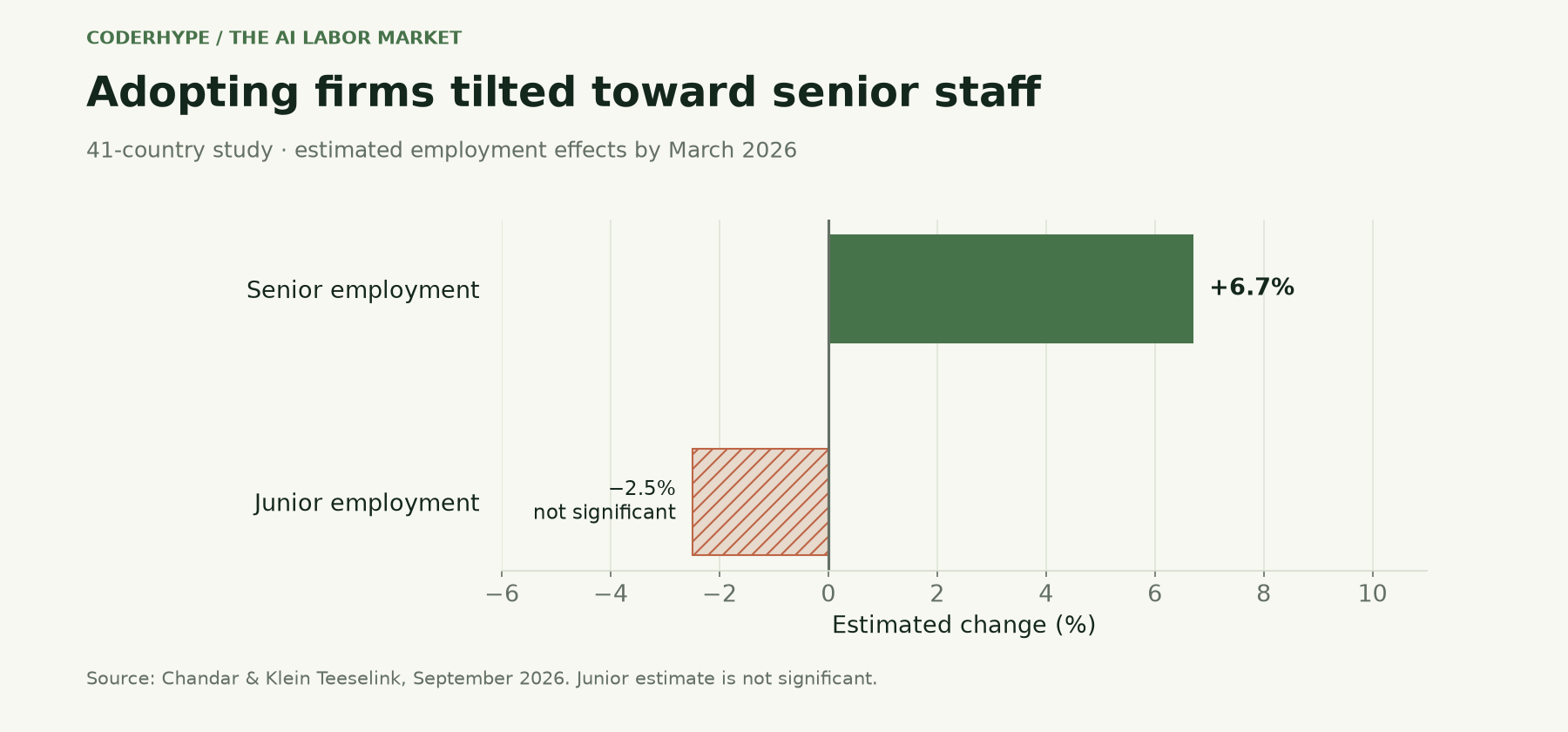
Matched comparisons and instrumental variables; results depend on identification assumptions. Adopters may also gain competitors’ business.
Imagine a team adds experienced engineers while keeping its junior headcount unchanged. Juniors become a smaller proportion of that team without anyone losing a job. This is why headcount, hiring flows and workforce shares deserve separate charts. The distinction is especially important when a global firm-level result is discussed as if it were a national unemployment statistic.
What a model can do is not what employers have replaced
Anthropic’s March study makes this distinction visible. For computer and mathematical occupations, theoretical task coverage reaches 94%, while its measure grounded in observed Claude activity reaches 33%. Neither is a percentage of jobs eliminated. The company does not observe all AI use, and capability alone does not establish reliable, economical deployment. Massenkoff and McCrory; Anthropic
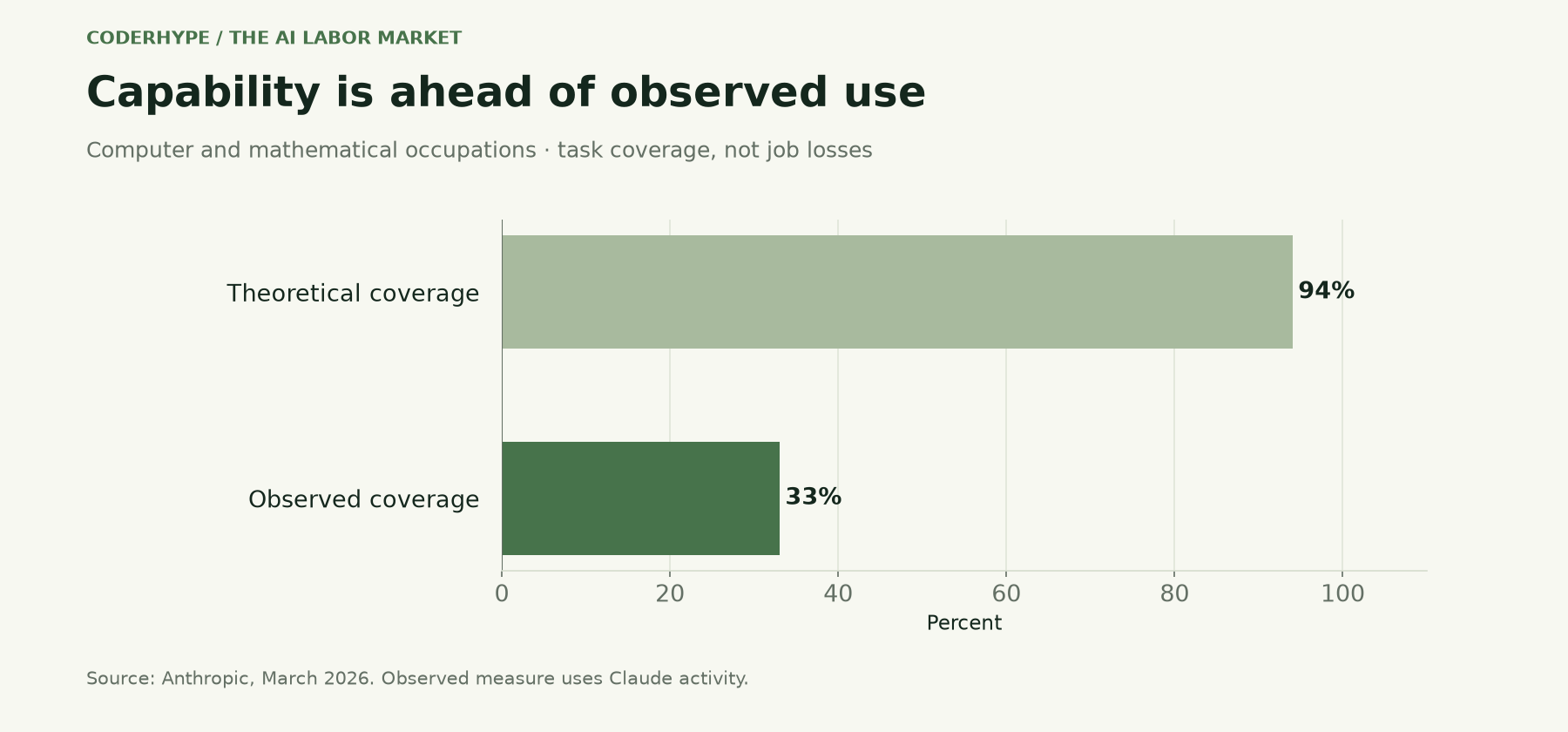
The same research finds no statistically significant relative unemployment increase in its most exposed group. It does find suggestive evidence of slower job-finding among exposed workers aged 22–25: an estimated 14% reduction, with borderline statistical significance. That combination is compatible with a tightening entrance rather than an immediate collapse of the entire occupation.
A task can be technically automatable while remaining attached to a human job because the surrounding work requires access, verification, coordination or liability. Conversely, automating a small but expensive bottleneck could change staffing substantially. Counting tasks gives a useful map of potential change; it cannot be converted mechanically into a redundancy forecast.
Europe is not simply the US with a delay
The EIB’s January working paper links investment-survey and company-account data, with EU firms and a US comparison. Its instrumental-variable estimates put AI’s labor-productivity effect at about 4%, without detecting adverse short-run employment effects. Benefits are concentrated in medium and large companies and accompanied by complementary investment. This studies broader AI adoption, not just chatbots. Aldasoro and colleagues; EIB 2026/02
It is a productivity-level estimate under a particular research design—not four extra percentage points of European annual growth, and not proof that no firm has cut jobs. A productive adopter may sell more, reorganize tasks or capture another company’s customers. National employment requires accounting for all those responses.
Mind the Gap, published in April, compares European and US worker and firm surveys from 2025–2026. Industries with greater adoption show faster productivity growth, but the authors find no clear employment association. They explicitly do not establish causality. Differences in management practices and employer encouragement are part of the adoption story. Bick and colleagues; IZA 18521
Norway supplies an important counterexample to the early-career narrative. A 2026 CESifo paper follows population registers from 2015 to March 2025 and finds no robust displacement of young workers. Small negative estimates are not statistically significant, and placebo timing tests point to pre-existing trends. This is evidence about Norway’s early adoption period, not a guarantee about late 2026. Facius and Iacono; CESifo 12752
Golo Henseke’s April paper uses the 2024 European Working Conditions Survey, covering more than 36,600 workers in 35 countries. Skills, workplace influence, training and national digitalization help explain adoption. A shift-share design detects no early effect on reported task restructuring. Once again, an absence of a detectable effect is different from establishing an effect of exactly zero. Golo Henseke
These studies make a single US–Europe “AI jobs lost” league table indefensible. The data windows, occupations, adoption measures and institutions differ. The useful comparison is between mechanisms: who adopts, who receives training, which tasks change and where hiring slows.
Companies expect more change than they report so far
Firm Data on AI surveys nearly 6,000 executives in the US, UK, Germany and Australia. Most report little realized employment or productivity impact over the preceding three years. Looking ahead three years, their average forecasts are +1.4% productivity, +0.8% output and −0.7% employment. These are expectations, not observed outcomes or annual growth rates. Yotzov and colleagues; Atlanta Fed / NBER
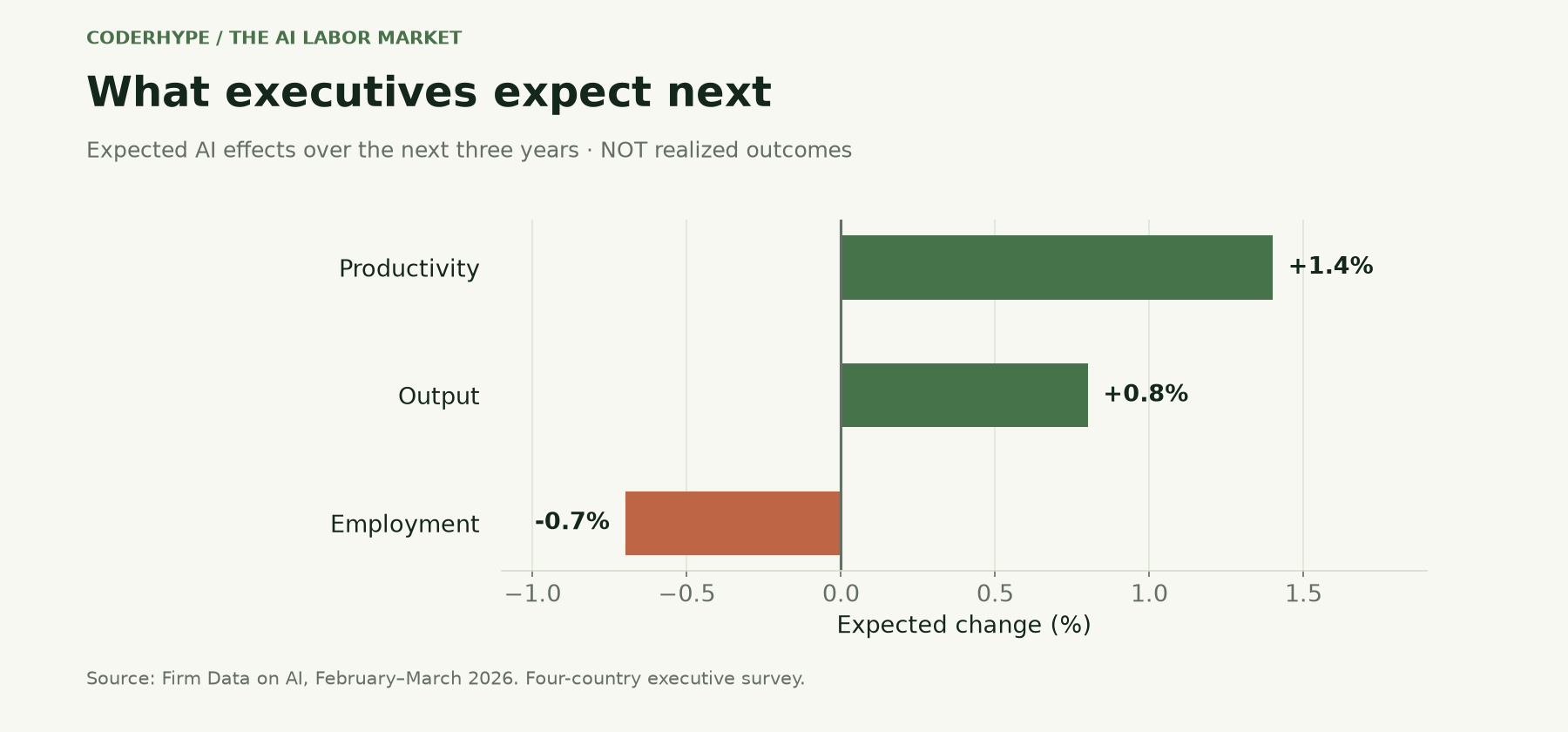
Forecasts reveal what managers think they may do. They do not tell us whether those plans survive implementation costs, customer demand, regulation or competitors’ responses. A company can believe automation will save labor and later discover that integration requires more people than expected.
The causal argument is still open
A January paper by Morgan Frank and colleagues finds that unemployment risk in AI-exposed US occupations began worsening in early 2022, before ChatGPT’s release. Its profile data also show earlier changes in graduate entry patterns. This does not rule out later AI effects; it makes “everything after November 2022 was caused by ChatGPT” a poor research strategy. Frank and colleagues
A June New York Fed analysis proposes another mechanism: remote work can make training inexperienced employees harder. Its back-of-the-envelope calculation attributes 64% of the increase in young college graduates’ unemployment between 2017–2019 and 2022–2024 to remote work. That is not 64% of unemployment, and it is not a measured 2026 AI effect. It is a competing explanation worth testing. Emanuel, Harrington and Pallais; New York Fed
Both AI substitution and reduced training opportunities could operate together. Interest rates, post-pandemic hiring corrections and changing demand can also affect the same occupations. Finding a credible AI effect requires showing why these alternatives do not explain the comparison—not merely drawing a vertical line at ChatGPT’s launch.
What this means for the main digital professions
Software engineering: demonstrate ownership beyond the first draft
The entry-level vacancy evidence above is more informative than claims that “coding is dead.” It concerns a particular part of the career ladder. Our practical interpretation is to make a portfolio show the work surrounding code generation: requirements, tests, deployment, failure diagnosis and decisions about trade-offs. A working demo and a reliable service are different deliverables.
This applies across front-end, back-end and full-stack work, but the reviewed studies do not support a precise replacement rate for each specialty. Nor do they establish that every experienced engineer benefits. A job title can conceal very different responsibilities; seniority is an imperfect proxy for the work someone actually owns.
Design, UX and video: automation reaches production unevenly
Adobe’s June report finds growing US creative ads and AI requirements between two snapshots. Its photography survey shows uneven uptake by task. Both are descriptive findings, not employment estimates. Adobe; Future of Creative Work, volume 1
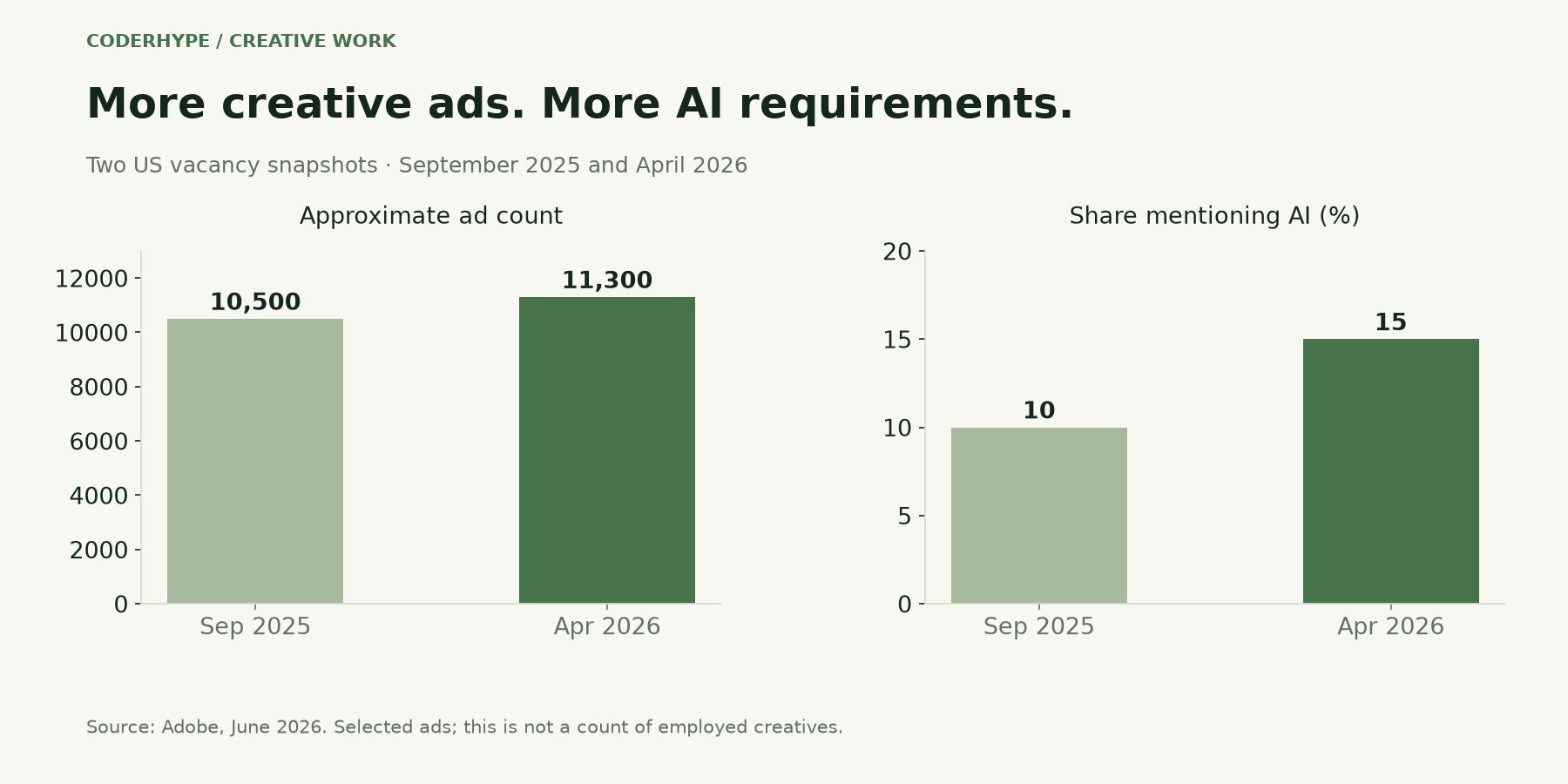
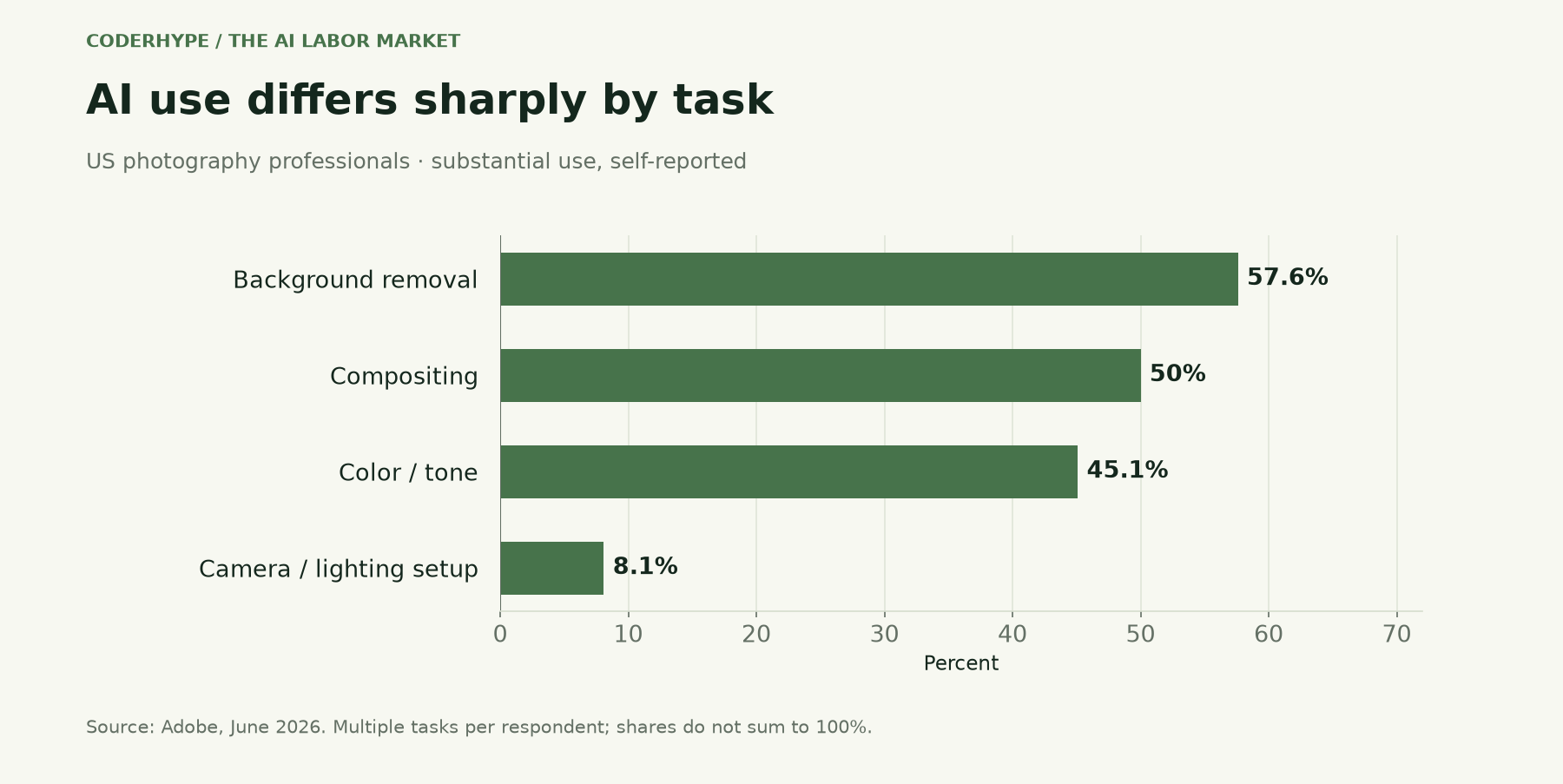
For UX designers and video editors, our inference is to separate making an asset from deciding what the asset must accomplish. User research, accessibility decisions, pacing, factual accuracy and client approval require their own evaluation. These examples describe workflows to examine, not occupations proven immune to automation. The reviewed evidence does not establish a reliable 2026 US-versus-Europe employment change specifically for video editors or UX researchers.
Copywriting, SEO and performance marketing: output is not the outcome
The AMA’s July careers report draws on 1,412 marketing practitioners surveyed in December 2025–January 2026, plus interviews and external data. Its task framework places execution-heavy activities such as email, SEO, paid media and copywriting closer to automation, while giving strategy and judgment a larger human role. That framework is an assessment of tasks, not a causal estimate of jobs lost. American Marketing Association
A useful background comparison comes from Bloomberry’s global job-ad analysis, originally published in 2025 and updated in June 2026. For comparable 2025 and 2024 periods, it reports all ads down 8%, computer graphic artists down 33%, and writers down 28%. The dataset covers nearly 180 million postings, but it cannot isolate AI from other forces. These are not US-only figures or new 2026 outcomes. Henley Wing Chiu; Bloomberry
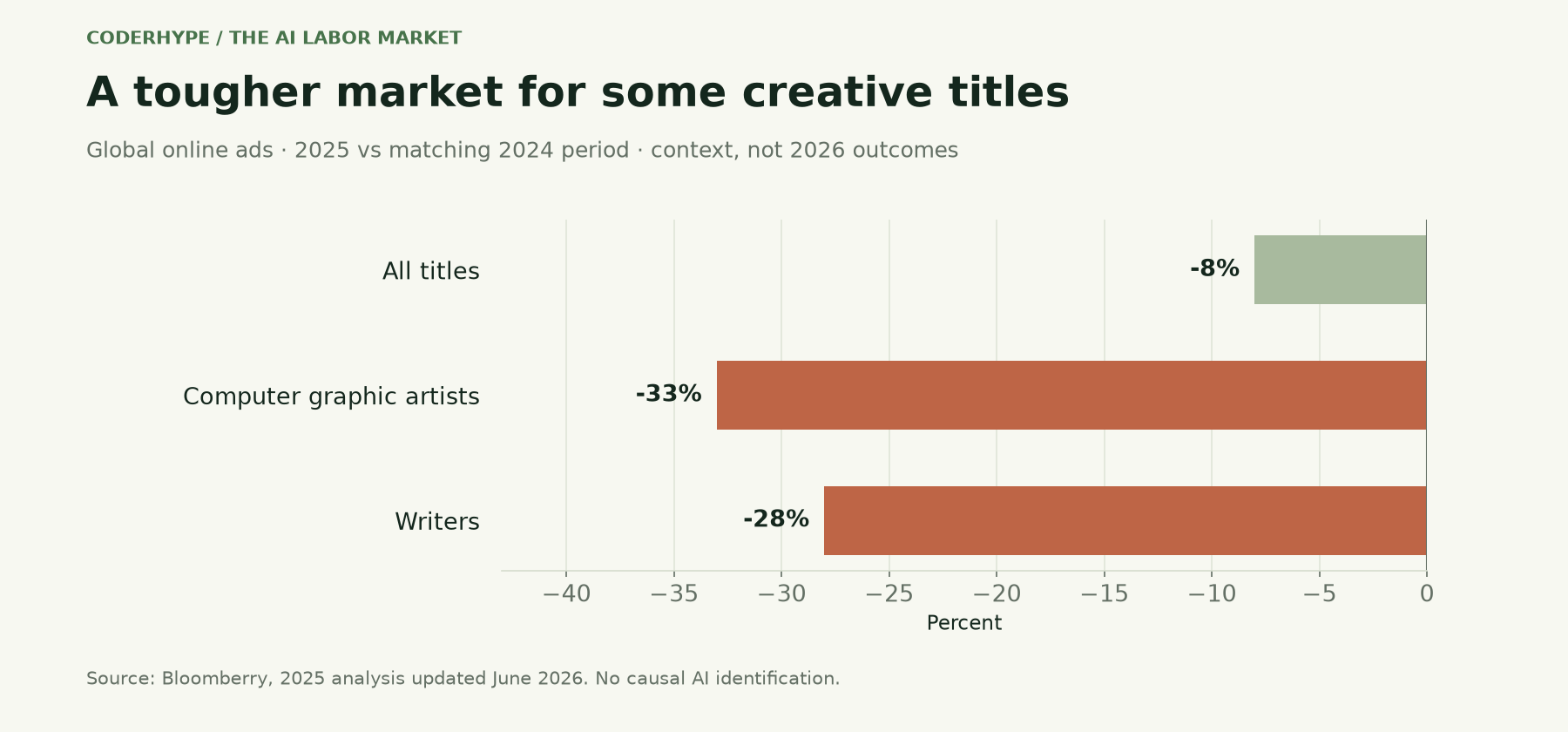
For marketers, we would track conversion quality, incremental revenue, retention and distribution—not just how many articles or ad variants a tool produces. A campaign can generate more material while becoming less effective. The reviewed research does not justify a universal salary penalty for copywriters, a guaranteed AI premium for marketers, or a percentage of SEO specialists already replaced.
Data analysis and BI: checking the question becomes part of the job
The OECD’s June AI and skills brief highlights data interpretation and digital skills alongside problem-solving and management. It is a synthesis, however: its latest underlying data end in late 2024. We should not relabel its older survey results as fresh 2026 hiring evidence. OECD
Our reading for analysts is practical: generated SQL is useful only if the metric, joins and population are right. A dashboard can be beautifully automated and still count the wrong users. A stronger work sample would explain missing data, leakage, causal limits and business decisions. This review does not establish that BI analysts are losing jobs at a particular rate, or that moving into machine learning guarantees higher pay.
Cybersecurity, cloud and AI infrastructure: adoption creates work around the model
Linux Foundation Research’s June survey identifies shortages across European technical teams. Its 157 Europe respondents are an industry sample, not a workforce census. Linux Foundation Research
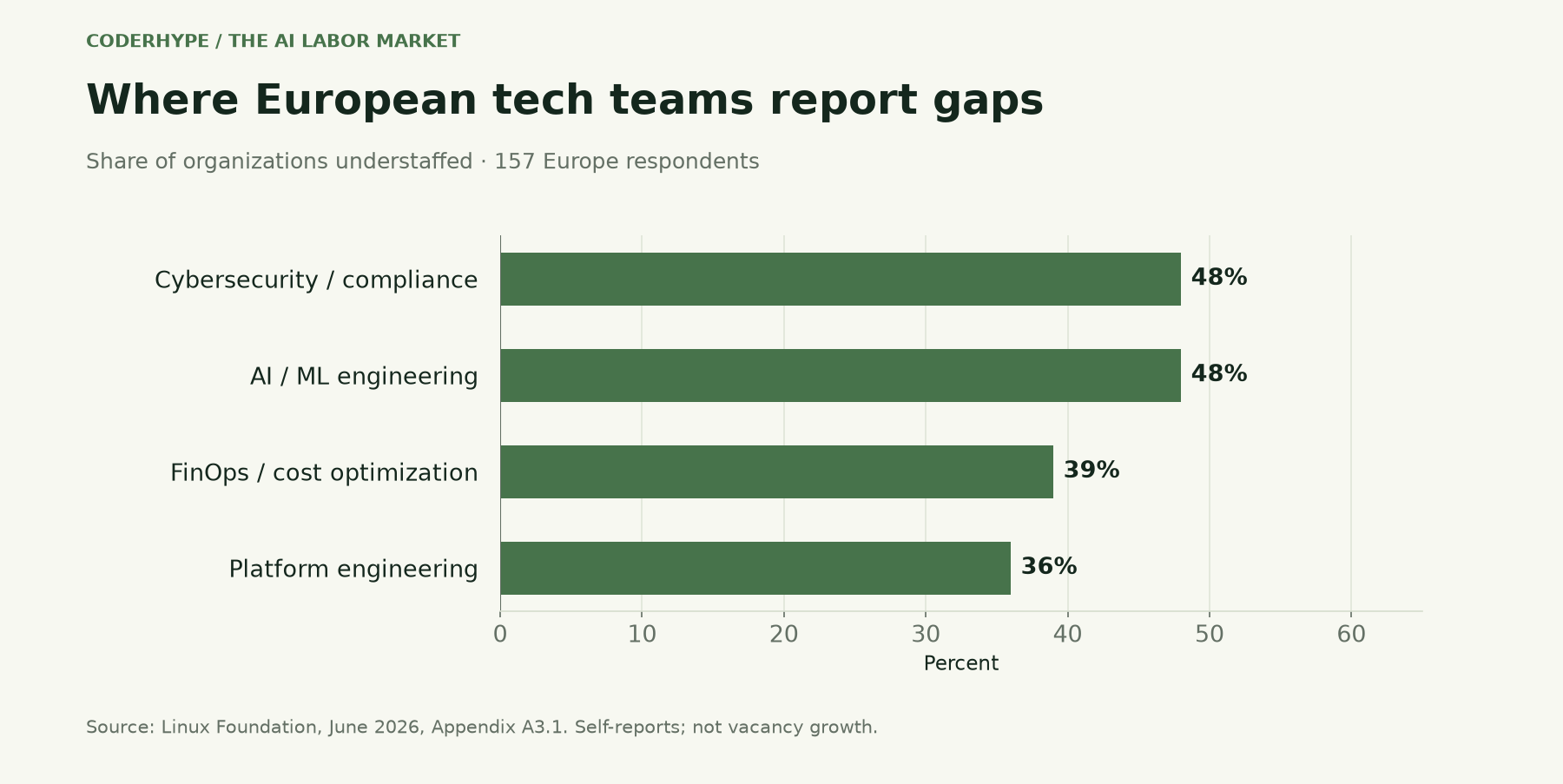
For entry-level technical positions during 2025, 25% reported an AI-related decrease, 53% no change and 22% an increase. These are shares of organizations, not workers.
For DevOps and security practitioners, our inference is that evaluating models is only one part of implementation. Access controls, observability, incident response, data boundaries and cost management still need owners. This suggests capabilities to investigate; it does not establish that these roles are protected from future automation or restructuring.
QA, customer support, translation and product management: avoid fake precision
These occupations contain tasks that models can assist with, but the research reviewed here does not provide equally strong, separate 2026 employment estimates for each. We therefore do not assign them a numerical “replacement probability.” Treating missing evidence as safety would be as misleading as filling the gap with a frightening percentage.
| Work area | Workflow to examine | Outcome worth measuring |
|---|---|---|
| QA and testing | Generated tests, exploratory testing, release decisions | Escaped defects and review effort, not test count alone |
| Customer support | Routine replies, escalations, refunds and sensitive cases | Resolution quality, repeat contacts and customer outcomes |
| Translation and localization | First-pass translation, terminology, cultural and legal review | Correction time and consequential errors |
| Product and project management | Summaries, specifications, prioritization and coordination | Decision quality and delivery, not document volume |
CoderHype’s suggested evaluation framework. This table is editorial analysis, not a finding that a study measured all four professions.
Knowing how to use AI can help—but a certificate is not a job offer
A revised March hiring experiment asks 1,725 recruiters in the US, UK and Germany to assess hypothetical candidates for software engineering, graphic design and office-assistant roles. AI skills improve interview-invitation probabilities by 8–15 percentage points across comparisons. Randomization supports a causal interpretation inside the experiment; it does not measure actual job offers or wage increases. Stephany, Teutloff and Leone
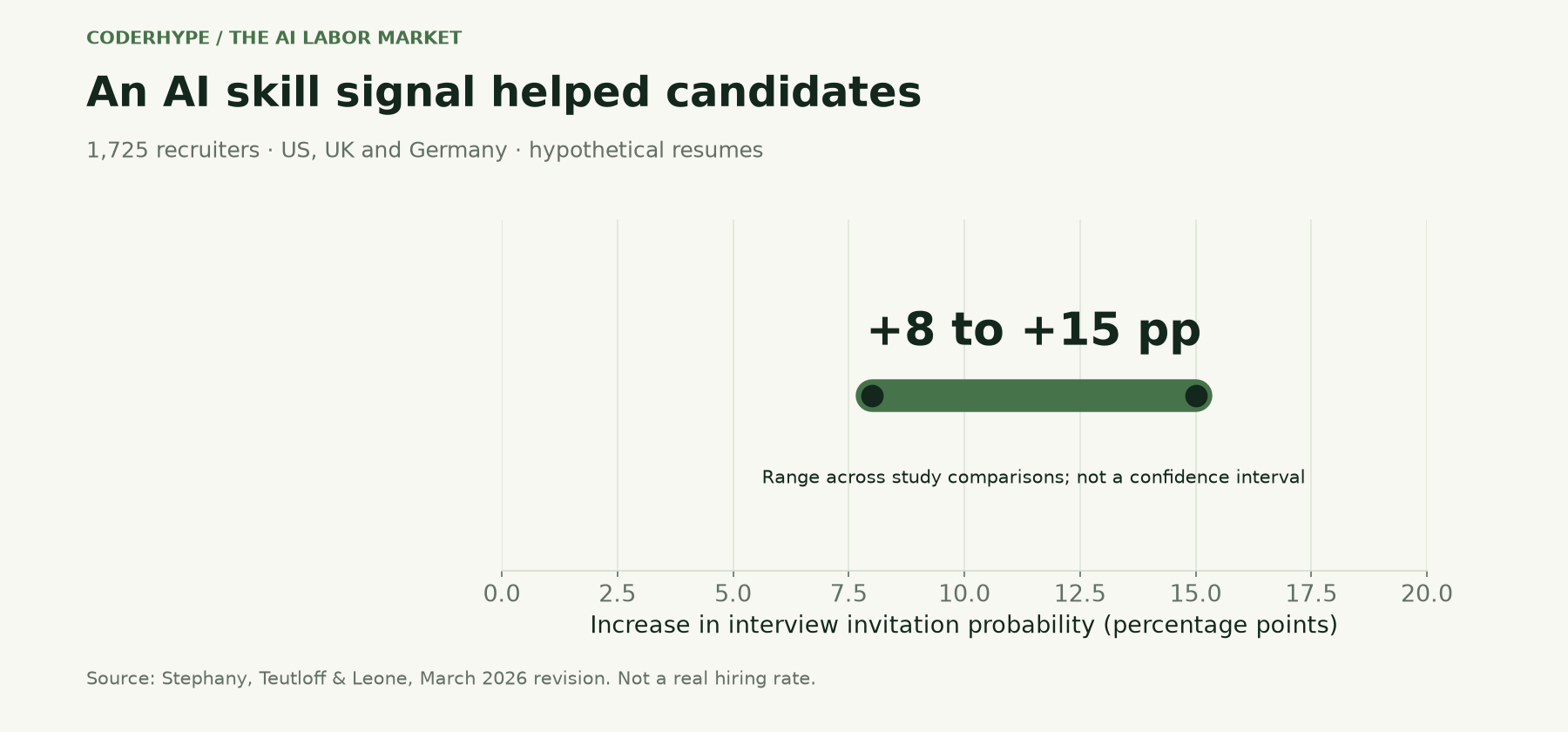
The actionable distinction is between signaling familiarity with a tool and demonstrating useful work. A recruiter’s response to a resume is one stage of hiring. Whether a candidate can deliver accurate, maintainable work is another.
Which relationships survive a careful reading?
| Relationship | What the reviewed evidence supports | What it does not establish |
|---|---|---|
| Exposure and early-career outcomes | Warning signals in several US datasets | A universal causal job-loss rate |
| Adoption and productivity | Positive industry correlations; some firm-level identification | Identical gains for every worker or a national growth forecast |
| Adoption and seniority | Changes in workforce composition | That every falling junior share represents layoffs |
| AI skills and recruiter interest | A positive effect in a randomized resume experiment | The same increase in real employment or salary |
| Automation and creative work | Uneven task use and changing requirements | The disappearance of an entire creative profession |
One geographic caution comes from the ILO–World Bank’s March research across 135 countries. Similar occupational titles can involve different tasks, and digital infrastructure changes both exposure and the ability to benefit. Its global exposure analysis is not a count of layoffs, but it explains why mechanically exporting a US occupational score to another country is unreliable. ILO and World Bank
Wages are another gap. A higher advertised salary for AI-skilled candidates could reflect occupation, experience, firm size or location. Without a suitable comparison, it does not tell us what the same person would earn after taking an AI course. We found no defensible single “2026 AI salary premium” applicable to all the digital professions in this article.
Our interpretation: the career ladder matters as much as the job count
The most useful reading of this evidence is that AI changes the composition of work before its aggregate employment effect becomes easy to measure. That is our synthesis, not a pooled statistical estimate. The studies do not share a common outcome, geography or observation period, so averaging their percentages would manufacture a number with no clear meaning.
First, a stable workforce can hide a broken entry route. Employers can retain experienced people while making fewer junior hires. If that persists, the consequence is not just a difficult graduate recruitment season. It raises a longer-term question: who will acquire the practical experience needed to become the next generation of senior staff? An organization that automates beginner tasks still needs a way to teach judgment.
Second, productivity is a business choice as well as a technical capability. Time saved can become more output, higher quality, shorter working hours, higher margins or fewer positions. Those outcomes depend on demand and organizational decisions. A faster tool does not determine how its gains will be distributed.
Third, the meaningful unit is often a responsibility, not a profession. Writing a draft, producing a chart or generating code is different from deciding what is needed and accepting responsibility for the result. That does not make judgment permanently unautomatable. It means a task-based account is more useful than declaring whole occupations safe or obsolete.
Fourth, AI literacy needs something to attach to. For an independent builder, that might be a deployed product, a measured acquisition experiment or a workflow that users trust. For an employee, it could be domain knowledge, operational ownership or the ability to evaluate failure. Knowing the interface of a popular tool is easier to demonstrate than those capabilities, but it is also easier for someone else to acquire.
Finally, we would watch hiring flows rather than wait for a dramatic unemployment headline. Junior vacancy shares, actual first-job transitions, experience requirements and promotion opportunities can reveal distributional changes earlier. Alongside them, track pay, workload, quality and who receives training. A labor market can become less accessible or less pleasant without suddenly employing far fewer people.
For CoderHype’s audience, the opportunity is to use cheaper production to build something with evidence of value. The challenge is that cheaper production alone is not a durable advantage. A shipped application, real users and documented decisions can tell a more convincing story than a claim that an AI assistant wrote most of the code.
Research register and how to read the charts
We searched academic working-paper repositories, university research groups, central-bank and international-organization publications, and relevant industry reports. We prioritized primary publications with identifiable methods and data relevant to the US, Europe or digital work. We excluded unsupported layoff tallies, anecdotal replacement claims and future projections presented as observed results. This selection is not a formal meta-analysis and does not claim complete coverage.
The register distinguishes new research, revisions, surveys and contextual sources. Two publications based on the same underlying evidence are not independent confirmations. Broad AI, generative AI exposure and observed use are different measures. Several 2026 publications analyze 2024 or 2025 data; the charts explicitly retain those dates.
All eight charts were redrawn by CoderHype from reported figures. No time-series points, confidence intervals or country estimates were invented. The recruiter chart shows a range of reported comparisons, not an uncertainty interval. The global employment chart marks a statistically insignificant result. Download the chart data and source IDs.
| Source | Publication | Coverage and method |
|---|---|---|
| Canaries in the Coal Mine: Six Facts about the Recent Employment Effects of Artificial Intelligence Stanford Digital Economy Lab |
2026-08-12 revision; first released 2025 | US payroll; through June 2026 Observational; counterfactual comparison |
| Generative AI and the Redefinition of Entry-Level Software Work Westby, Modestino and Cheng; IZA 18723 |
June 2026 | US vacancies, January 2019–March 2025 Event study and difference-in-differences |
| How Does AI Change Labor Demand? Evidence from 41 Countries Chandar and Klein Teeselink |
September 2026 | Affiliate panel, January 2021–March 2026 Matched firms and instrumental variables |
| Labor market impacts of AI: A new measure and early evidence Massenkoff and McCrory; Anthropic |
March 2026 | US occupations; Claude usage and labor surveys Exposure measure and observational outcomes |
| AI adoption, productivity and employment: Evidence from European firms Aldasoro and colleagues; EIB 2026/02 |
January 2026; manuscript dated December 2025 | EIBIS 2019–2024 and ORBIS; EU / US Instrumental-variable estimates; broad AI |
| Firm Data on AI Yotzov and colleagues; Atlanta Fed / NBER |
February–March 2026 versions | Nearly 6,000 executives; US, UK, Germany, Australia Survey reports and three-year expectations |
| Mind the Gap: AI Adoption in Europe and the US Bick and colleagues; IZA 18521 |
April 2026 | Worker and firm surveys, 2025–2026 Adoption comparisons and industry correlations |
| The Labor Market Consequences of Generative AI: Early Evidence from Norway Facius and Iacono; CESifo 12752 |
2026 | Norwegian registers, 2015–March 2025 Within-firm and synthetic difference-in-differences |
| AI-exposed jobs deteriorated before ChatGPT Frank and colleagues |
January 2026 | US unemployment insurance, profiles and curricula Timing and observational comparisons |
| Remote Work Leaves Younger Workers Sidelined Emanuel, Harrington and Pallais; New York Fed |
June 2026 | US; comparisons of pre- and post-pandemic periods Research analysis and explanatory calculation |
| From Exposure to Adoption: Generative AI in European Workplaces Golo Henseke |
April 2026, version 3 | 2024 European Working Conditions Survey; 35 countries Worker survey and shift-share design |
| AI Skills Improve Job Prospects: Causal Evidence from a Hiring Experiment Stephany, Teutloff and Leone |
March 2026 revision | 1,725 recruiters; US, UK and Germany Randomized hypothetical resume experiment |
| How AI is redistributing creative work Adobe; Future of Creative Work, volume 1 |
June 2026 | US vacancy snapshots; US/UK creative surveys Vendor research; ads and self-reported task use |
| 2026 State of Tech Talent: Europe Linux Foundation Research |
June 2026 | 157 Europe respondents; 241 elsewhere Industry survey, not a workforce census |
| 2026 State of Marketing Careers Report American Marketing Association |
July 2026 | 1,412 practitioners; December 2025–January 2026 Survey, interviews and secondary job-market data |
| I analyzed 180M jobs to see what jobs AI is actually replacing today Henley Wing Chiu; Bloomberry |
2025 original; updated June 2026 | Global job ads, January 2023–October 2025 Descriptive industry analysis; context only |
| AI and skills: What we know so far OECD |
June 2026 | Synthesis; latest underlying data late 2024 Policy review; not a new 2026 outcome dataset |
| Disruption without dividend? ILO and World Bank |
March 2026 | 135 countries; approximately two-thirds of global employment Modeled exposure and infrastructure constraints |
Editorial cutoff: October 15, 2026. Findings may change with revisions, longer observation windows and better evidence on actual adoption. The recommendations and final interpretation are CoderHype’s own.