
Building a Vibe-Coded SaaS? 4 Real Revenue Case Studies — November 2026
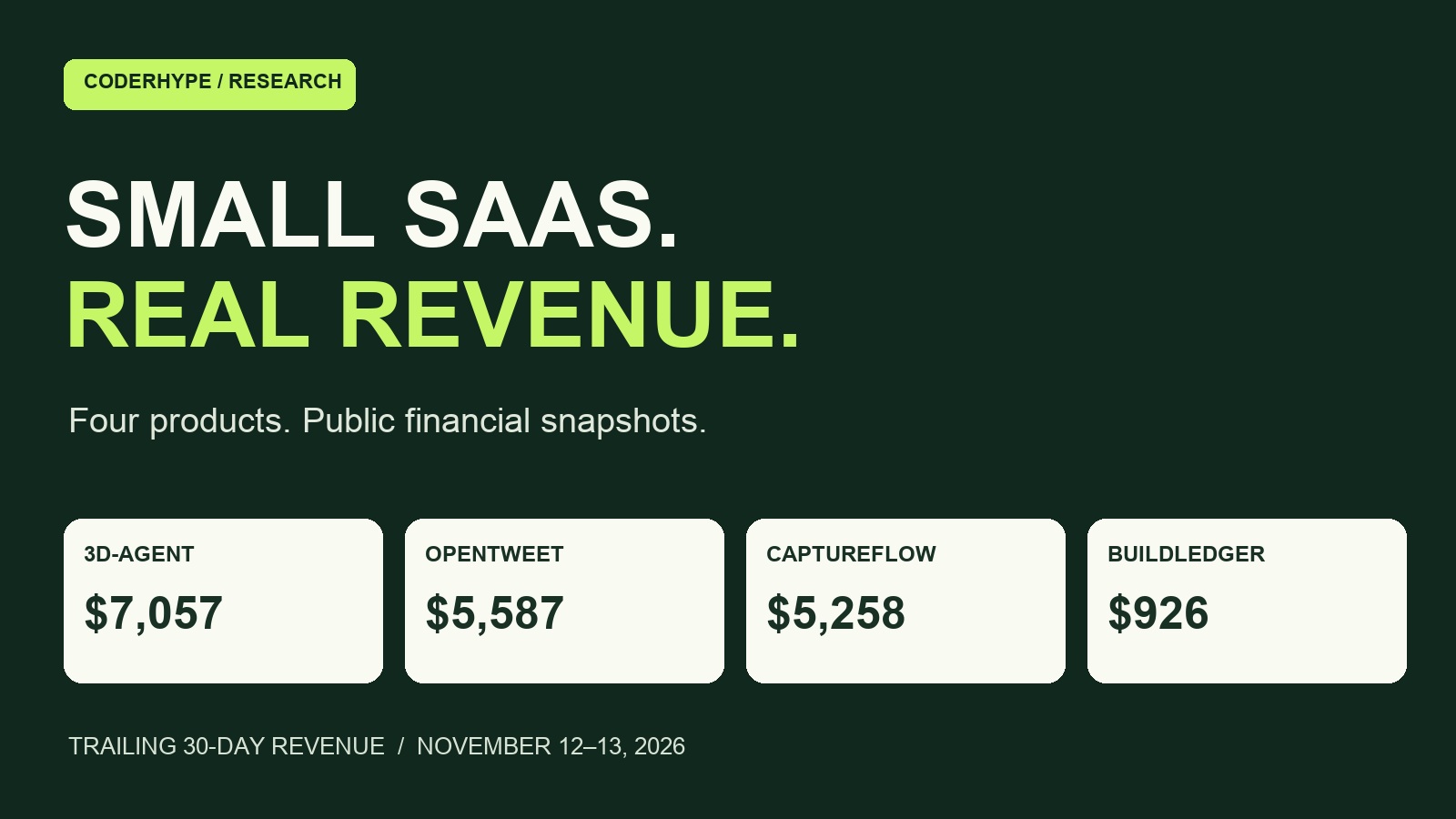
A social posting tool, an AI content workspace, a Blender assistant and software for builders have little in common on a product roadmap. They do have something more useful in common: identifiable websites and public financial pages showing paying activity. That makes them a better starting point for studying small software businesses than an anonymous claim of spectacular monthly revenue.
We looked at OpenTweet, CaptureFlow, 3D-Agent and BuildLedger using financial snapshots updated on November 12–13, 2026. Their reported monthly recurring revenue ranges from $1,648 to $6,951. This is a selection of four observable businesses, not a ranking of the world’s most profitable SaaS products.
The numbers, with the dates left attached
The revenue column below covers the trailing 30 days in each snapshot, including part of October. MRR is the monthly equivalent of recurring subscription revenue at that point. Neither column is a completed November sales total. All figures are displayed in US dollars by TrustMRR.
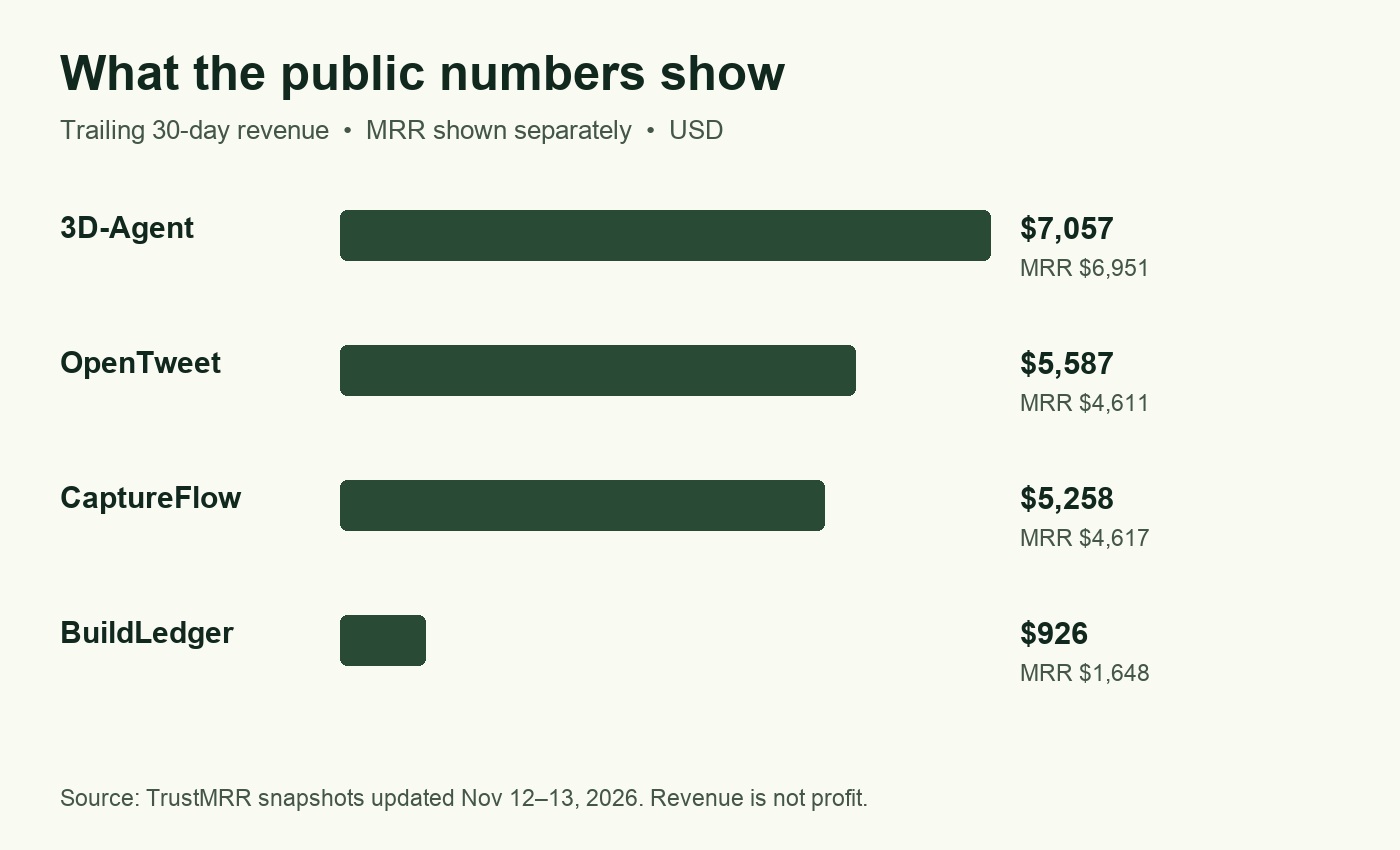
| Product | Trailing 30-day revenue | MRR | Updated | Financial source |
|---|---|---|---|---|
| 3D-Agent | $7,057 | $6,951 | Nov 13 | Stripe-connected snapshot |
| OpenTweet | $5,587 | $4,611 | Nov 12 | Paddle-connected snapshot |
| CaptureFlow | $5,258 | $4,617 | Nov 12 | Stripe-connected snapshot |
| BuildLedger | $926 | $1,648 | Nov 12 | Stripe-connected snapshot |
TrustMRR labels these figures as verified through connected payment-provider API keys. That is more informative than an unsupported social post, but it is not an audit of each business. It does not establish net profit, disclose every expense or prove that all company revenue flows through the connected account.
OpenTweet: the useful part came before the audience
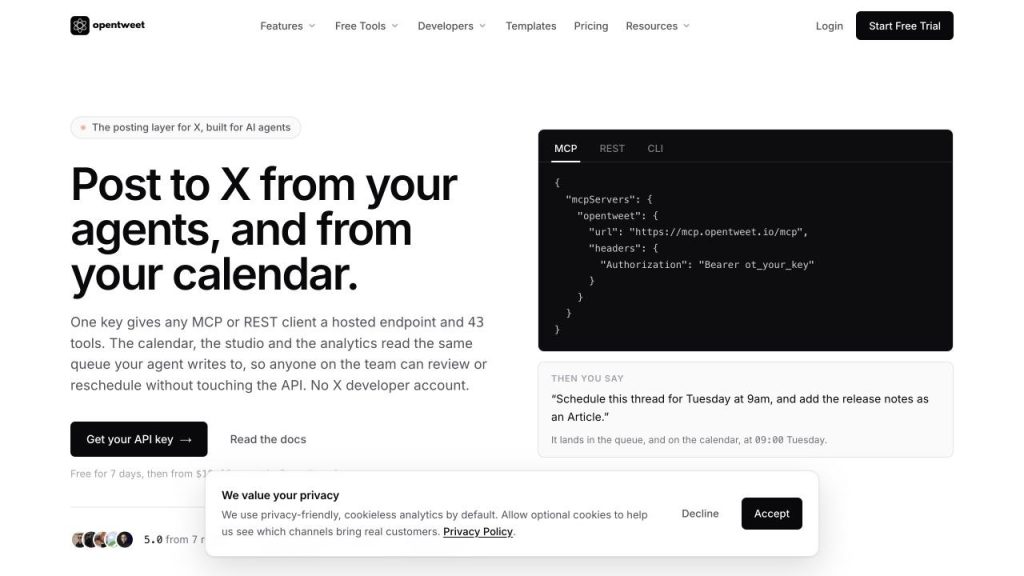
OpenTweet’s founder has supplied the clearest origin story of the four. In an October Reddit post, he described building a scheduler for his own use, initially running it locally, and later moving it online. A friend tried it and found problems he had missed. The story is less about inventing a category than getting a familiar task to work for somebody else.
His account of acquisition combines direct conversations, search-oriented pages, changes to pricing and integrations for agents. We cannot isolate the contribution of each channel. The useful lesson is the sequence: a personal problem, another person testing the product, then repeated work on distribution. A website appearing in search is not a customer acquisition strategy unless the visitor can understand why to buy.
The current product website puts automated publishing beside a visual calendar. Our interpretation is that this sells control as much as automation: an agent can create work, while a person can still inspect it. The remaining business question is how much support and platform dependency sit behind that convenience.
CaptureFlow sells the handoff between expertise and content
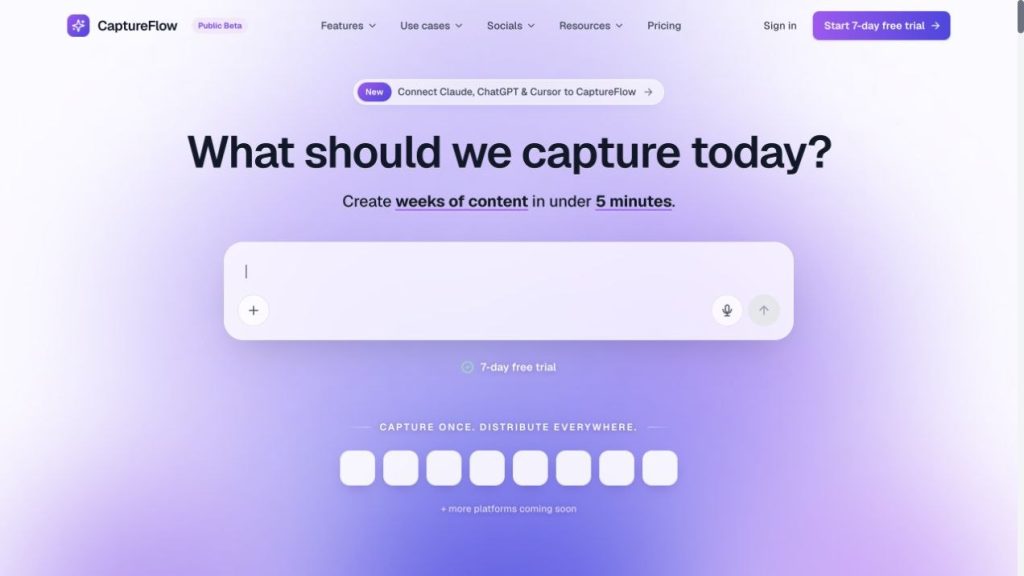
A founder can have plenty to say and still fail to publish regularly. The costly part may be turning a recording into a clear draft, adapting it for another channel and getting it out the door. CaptureFlow packages that sequence into one workspace.
That gives it a more specific purchase argument than “AI can write.” A buyer can compare the workflow with the time currently spent passing material between tools or people. Whether the resulting content deserves publication is a separate test. It still needs checking for factual drift, repetition and a voice that fits the person whose expertise is being reused.
Its public finances show revenue, but they do not reveal the cost of serving each account. We would want usage, support burden and renewal behaviour before judging the quality of the business. The eight active subscriptions shown in the snapshot should not be casually rewritten as eight individual users: one billing subscription can represent a broader arrangement.
3D-Agent: a generated scene has to survive the next step

3D-Agent brings instructions into Blender. Its public demonstrations are visually compelling, but the commercial question is more specific than whether AI can produce an attractive image. Can an artist use the result in the next stage of a project?
For this kind of tool, a credible evaluation means opening the resulting scene, examining the geometry and making changes. A model that needs extensive repair may still be useful, but its value depends on the time saved after cleanup. A polished render alone cannot answer that question.
The subscription snapshot makes this an actual monetization case rather than a demo-only story. It does not tell us retention or whether the most demanding customers are economical to serve. For builders considering a similar product, the lesson is to connect an impressive capability to an existing workflow whose users already know what a usable result looks like.
BuildLedger: an unglamorous problem with a clear buyer
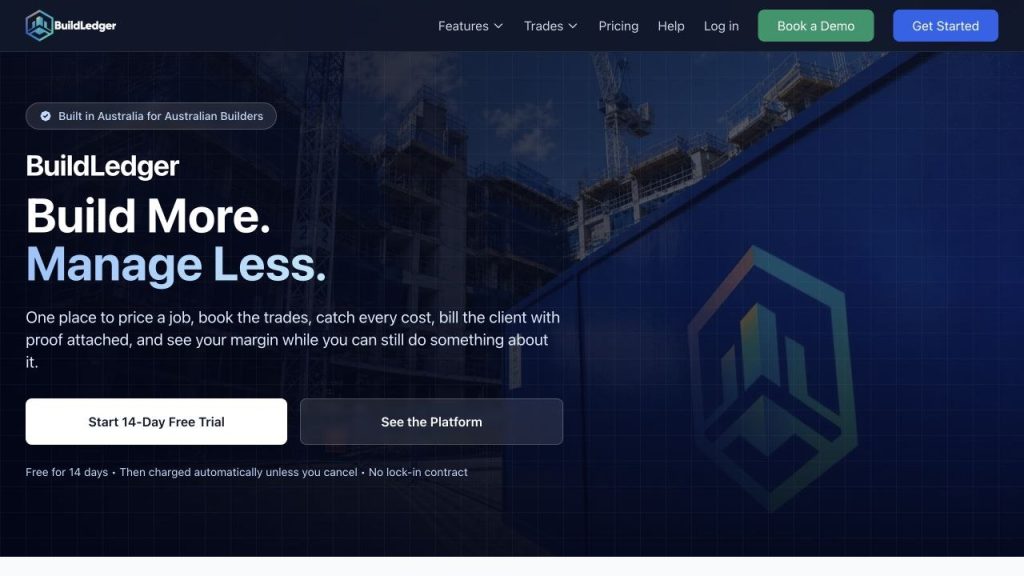
BuildLedger is the smallest business in this selection by observed trailing revenue. It may also be the easiest to understand without an AI pitch. Building jobs involve estimates, suppliers, changes, invoices and payments. Losing track of those records makes it harder to know what a project earns.
The product targets the administration of Australian construction businesses. It should not be confused with a floor-plan generator or structural design package. That specificity matters: the intended buyer has an ongoing operational job, rather than a general desire to experiment with new software.
Its MRR is higher than the cash collected in the trailing window. We have kept both numbers instead of choosing the more flattering one. Billing schedules and subscription changes can cause these measures to differ; the public snapshot does not identify the explanation here. Eleven active subscriptions are enough to make this worth observing, but not enough to establish durable product-market fit.
What these cases suggest for the next small SaaS
Our reading is that the most transferable idea is a bounded, recurring task. Publish an approved queue. Reuse a source recording. Edit a scene inside an established application. Keep costs connected to a construction job. Each can be described in terms a potential buyer already understands.
That does not mean any clone of these products will find customers. An existing business has accumulated integrations, feedback, trust and distribution that a fresh interface does not inherit. The useful research exercise is to identify an underserved workflow and test whether people will pay for its completion, then measure the cost of delivering it reliably.
We also found no sufficient evidence to describe all four products as entirely vibe-coded. AI features, agent integrations and an AI-assisted development process are different claims. These are revenue-generating SaaS case studies relevant to builders; their engineering origin is not established by a payment dashboard.
Method: public websites and financial pages reviewed on November 13, 2026. CoderHype captured the screenshots; demonstrations shown within those pages are the vendors’ own examples. We did not test paid workflows, install the Blender plugin or access private customer data. Live financial pages may change after this snapshot.
Building something yourself? Submit your project to CoderHype and explain who it helps, what is working and what you have learned from real users.