
Nobody Wants to Listen to AI Music? What the Streaming Data Shows
The music arrives. The audience does not arrive at anything like the same scale. That is the uncomfortable gap behind the AI music boom: making another song is becoming easier, but persuading someone to choose it, finish it and return tomorrow remains a different job.
“Nobody wants to listen to AI music” is an effective provocation. As a literal statement, it goes further than the evidence. The more defensible argument is also more useful: an explosion in production is not proof of an explosion in genuine demand. Platform reports expose that distinction, even though their numbers cannot tell us how every listener would behave in a neutral experiment.
Research checked October 28, 2026. This analysis uses official Deezer, Qobuz and Spotify releases. These are platform-reported figures, not an independent audit or a representative measurement of the whole music market. Fully generated music, music made with some AI assistance, and spam are different categories.
Watch the video
Deezer has a supply boom. Listening tells a smaller story.
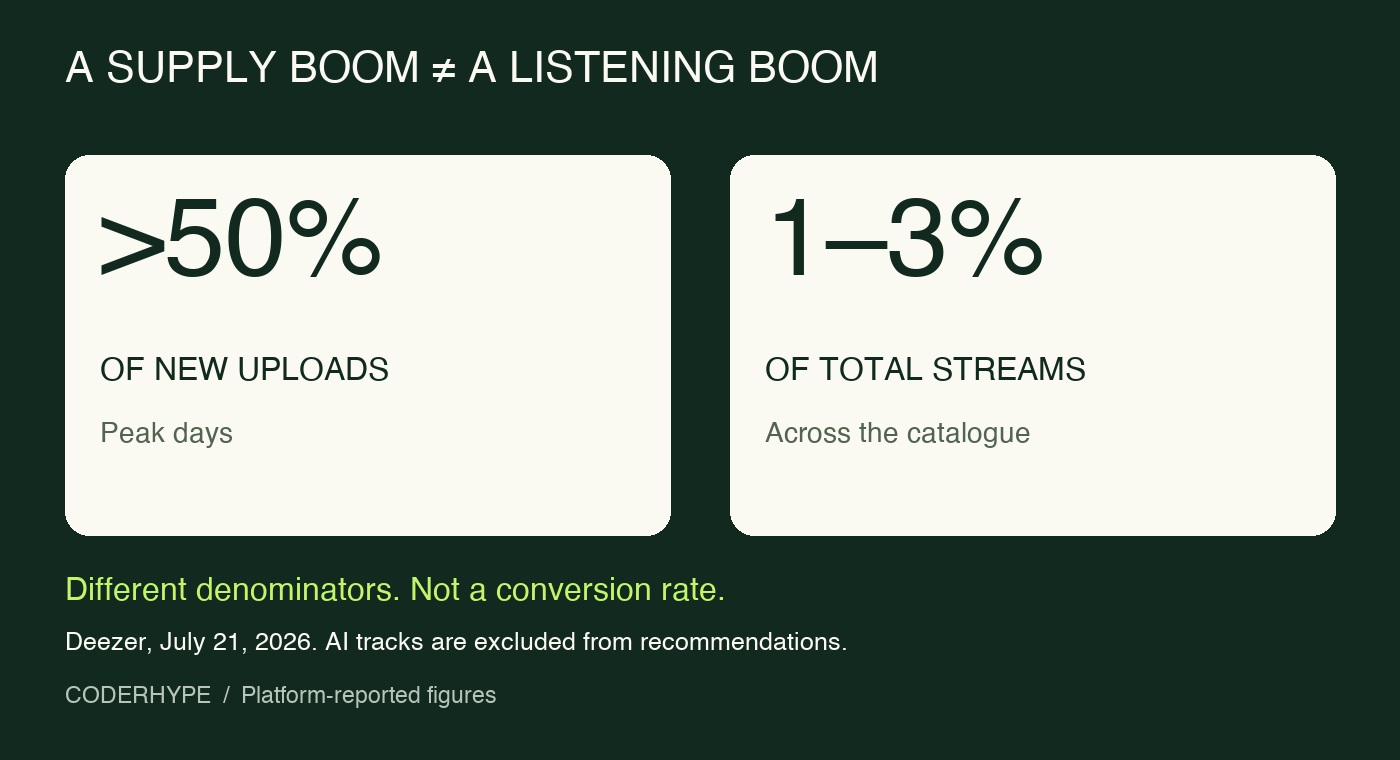
In its July 21 report, Deezer said fully AI-generated tracks exceeded 50% of daily new uploads on peak days, with roughly 90,000 arriving per day. Yet they represented just 1–3% of total streams. New deliveries and listening across an existing catalogue have different denominators: this is a contrast between production and consumption, not a conversion rate.
The same release repeated that up to 85% of streams on fully AI-generated tracks were fraudulent in 2025. That historical qualification matters. It is not a measured July 2026 fraud rate. Deezer excludes detected manipulation from royalty payments and removes identified AI music from algorithmic recommendations and editorial playlists. Its low listening share therefore reflects distribution policy as well as audience choices. Deezer, July 21, 2026.
A familiar startup mistake fits this picture: counting output as traction. A release is something a supplier can create. Demand requires someone on the other side to care. Automation can multiply the first without solving the second.
The newer Deezer announcement is about the right to opt out
Deezer’s October 13 update announced a search filter scheduled for global rollout before the end of 2026. Listeners would be able to exclude detected fully AI-generated tracks, albums and associated artists from search results.
It also reported more than 42 million AI-generated tracks excluded from recommendations between January 2025 and August 2026, and over 14 million albums tagged. Those are different units, not two counts to add together. The company cited a November 2025 Deezer/Ipsos survey in which 45% of music-streaming users wanted an option to filter out fully AI-generated music. Wanting the option is not the same as activating it or rejecting every synthetic song. Deezer, October 13, 2026.
Nevertheless, the product decision is revealing. A platform is treating the origin of music as a preference worth exposing in its interface. Sound quality alone is not the only possible criterion for choosing what to hear. A listener may also care about performance, authorship, identity or whether a person exists behind the artist profile.
Qobuz: a tiny listening share, with a substantial caveat
Qobuz’s September 24 announcement puts detected AI-generated music at 0.38% of all streams. It says 60% of streams on those tracks are classified as fraudulent and excluded from royalty payouts. Separately, it reports removing four million AI-identified albums with no listening activity from search. Albums are not tracks, and search removal should not be rewritten as universal deletion.
Qobuz explicitly connects the small share to its approach to discovery: AI-generated content is outside its human-curated selections. This is a useful second platform observation, but not a market-wide estimate or a clean comparison with Deezer. Audiences, catalogues, detection systems and promotion policies differ. Qobuz, September 24, 2026.
There is a tempting calculation here: multiply the AI stream share by the proportion not flagged as fraudulent and call the result “real demand.” We would not present that as an audited audience measure. The release does not give enough detail about aligned reporting windows and treatment of excluded streams. More fundamentally, a stream that passes a fraud filter is not automatically a fan who deliberately sought out an AI artist.
Spotify reports rejection signals, not an AI market share
On October 20, Spotify said it had excluded more than 50 million slop and spam tracks from recommendations during 2026. Separately, it cited over 75 million spam tracks removed from the platform. The latter is not a disclosed count of AI songs, and the statement does not establish the same 2026-only window for both totals.
Spotify says its analysis of skips, ignored tracks and negative feedback repeatedly identified slop or spam. It reports fewer listener concerns after changes, without publishing a numerical reduction. Its detection combines engagement, metadata, upload patterns and other signals.
Another striking claim: tracks with indicators of a high probability of AI generation were 10 times more likely to fall below its 1,000-stream royalty threshold. That is a relative likelihood, not a statement that 90% failed. The report supplies neither an AI share of all streams nor the baseline needed to turn that ratio into an absolute failure rate. Spotify, October 20, 2026.
A skip is a signal. It is not a complete explanation.
Imagine two songs receiving very different treatment. One reaches an established artist’s followers and editorial playlists. The other is omitted from recommendations and appears only when someone searches for it. Their stream counts cannot isolate which recording people prefer when given an equal opportunity to hear both.
Now imagine a listener skipping a track because the mix is poor, the mood is wrong, or the song interrupts a favourite playlist. Unless the experiment establishes what they knew, that skip does not prove they recognised and rejected AI. Conversely, a listener might enjoy a recording and still dislike deceptive claims about the performer.
These distinctions do not make the platform reports meaningless. They tell us what is happening inside particular distribution systems. They stop us from turning observations about those systems into universal claims about human taste.
The missing product is a reason to come back
Our interpretation is that the hardest part of a music business remains the relationship with the audience. A technically convincing song can be a demonstration. An artist people seek out repeatedly is a different achievement.
A potential listener has limited time and an existing library. A new release competes with favourite recordings, friends’ recommendations and artists whose work already carries personal meaning. Lowering the cost of making another track does not lower that competition for attention.
For an AI music product, we would therefore ask less about generation volume and more about voluntary return. Do people save songs? Search for the artist by name? Listen again a week later? Follow the creator after seeing an honest description of how the music was made? Those are proposed evaluation questions, not results supplied by the reports.
There may also be useful products that do not depend on building a conventional recording artist: a creator commissioning a specific soundtrack, a game needing adaptable background audio, or a person experimenting privately. Success in such a workflow would not prove broad demand for a streaming catalogue. Equally, weak catalogue demand would not establish that every creative use of generation is worthless.
What would change our mind?
A stronger test would compare disclosed human-made and fully generated music under similar exposure conditions, while controlling for genre, audience and promotion. It would report repeat listening and retention, not merely a first click. Fraud screening would be documented, and the research would separate preference for the sound from preference for the artist’s identity.
For commercial claims, we would also want the denominator. A few successful releases say little about the typical outcome if the total number of attempts is unknown. Large upload totals say equally little if the people producing those songs are not the people choosing to hear them.
The defensible conclusion is narrower than “nobody listens,” but tougher on the hype: making music abundant has not, by itself, demonstrated abundant listener demand. There is a business difference between generating a catalogue and earning an audience. A credible AI music success story has to show the second.
This is the same distinction we explore in our analysis of AI content and brand trust: cheaper production can improve an output metric while leaving the human reason to engage unresolved.