
How the AI Bubble Could Burst: 9 Scenarios Behind the Hype
The AI bubble does not need a spectacular technical failure to burst. It can collapse while the software keeps getting better. All it takes is a widening gap between what customers will pay for useful automation and what investors have already paid for the promise of something much bigger.
That is the uncomfortable possibility behind the research: assistants that help without replacing entire jobs, coding agents that impress on a first attempt and struggle with the next change, and benchmarks that travel badly into unfamiliar environments. Each can support a real business. None automatically supports the economics of unlimited growth.
This is a map of nine ways expectations could break, not a prediction that all nine will happen. Research findings, corporate surveys and analyst opinions carry different evidentiary weight. The evidence cutoff is October 19, 2026; older studies are dated explicitly rather than presented as tests of today’s models.
1. Revenue grows. The financing gap grows faster.
The simplest bursting scenario is financial. Customers buy more AI, but serving them and developing the next generation require more money than the business produces. Investors eventually demand a credible route to positive cash flow instead of another milestone in usage.
There is a concrete historical warning. In September 2025, Reuters relayed The Information’s report that OpenAI projected $115 billion in cumulative cash burn through 2029, while noting Reuters could not immediately verify it. This was a reported forecast, not an audited loss, not a 2026 annual loss, and not a current cash balance. It illustrates the scale of funding assumptions; it should not be recycled as a fresh financial disclosure. Reuters report.
Even a profitable individual API request does not prove that the company is profitable after research, salaries and infrastructure commitments. Conversely, a company investing heavily can lose cash today and still build a viable business. The question is whether the eventual margin and customer demand justify the amount invested.
Consider an explicitly hypothetical product. A customer pays $20 per month; inference, support and other variable expenses cost $12. That leaves $8 before fixed costs. If heavy usage pushes those expenses to $24, the same subscription loses $4 before research or marketing. Adding customers then increases the funding requirement. These are illustrative numbers, not estimates for any provider.
The warning signs would be repeated price increases, tighter usage limits, deteriorating retention and financing becoming harder to obtain. Cheap, useful AI could survive even as the companies that subsidised it lose their valuations.
Chinese price competition can puncture the premium
There is another way to break the economics without breaking the technology: competitors make sufficiently useful intelligence much cheaper. Chinese providers such as DeepSeek and Alibaba increase the pressure on what customers will pay per task. Calling this “dumping” is tempting, but the public tariffs do not establish below-cost selling, subsidies or a predatory strategy. The evidence here supports aggressive price competition.
The distinction matters. A provider can deliver better models and still lose pricing power if a cheaper alternative becomes good enough for a customer’s particular workload. Customers can reserve expensive models for difficult cases and route routine requests elsewhere. The result could be excellent for application builders while weakening the margins assumed in a model provider’s valuation.
US and Chinese API prices: a dated snapshot
Checked October 19, 2026; Google rows updated October 20, 2026. USD per one million tokens. These are selected first-party text API tariffs, not chat subscriptions or a quality ranking. Input means uncached input; output includes billable reasoning tokens where applicable. We exclude batch, caching, priority tiers, free allowances, taxes and tool charges. The country labels describe the provider’s origin, not where a request is processed.
The example column prices 1 million input plus 200,000 billable output tokens, spread across short requests. Formula: input price + 0.2 × output price. It fixes token quantities, not answer quality: different tokenizers, reasoning budgets and retries can change the real bill.
| Provider / model | Origin | Input / 1M | Output / 1M | Example bill | Rate used |
|---|---|---|---|---|---|
| OpenAI GPT-6 Astra | US | $10.00 | $50.00 | $20.00 | Standard, short context |
| OpenAI GPT-6.1 Sol | US | $2.00 | $10.00 | $4.00 | Standard, short context |
| OpenAI GPT-6 Luna | US | $0.10 | $0.50 | $0.20 | Standard, short context |
| Anthropic Claude Opus 5.5 | US | $4.00 | $20.00 | $8.00 | Base API, global routing |
| Anthropic Claude Sonnet 5.5 | US | $2.00 | $10.00 | $4.00 | Base API, global routing |
| Anthropic Claude Haiku 5.5 | US | $0.10 | $0.50 | $0.20 | Prompts ≤100,000 tokens |
| Google Gemini 4 Argon | US | $2.00 | $10.00 | $4.00 | Standard paid tier; through Nov 30, 2026 |
| Google Gemini 3.8 Flash | US | $0.75 | $3.75 | $1.50 | Standard paid tier; through Dec 31, 2026 |
| DeepSeek V4.1 Flash 1017 | China | $0.30 | $1.20 | $0.54 | Peak hours, cache miss |
| DeepSeek V4 Pro 0813 | China | $1.32 | $3.96 | $2.11 | Peak hours, cache miss |
| Alibaba Qwen3.7 Plus 2026-05-26 | China | $0.40 | $1.60 | $0.72 | Singapore / International, ≤256K input |
Official sources: OpenAI pricing, Anthropic pricing, Google pricing, DeepSeek pricing, and Alibaba Cloud pricing.
DeepSeek’s off-peak rates are half the listed peak rates: Flash costs $0.15 input / $0.60 output, and Pro $0.66 / $1.98. Peak periods are 01:00–04:00 and 06:00–10:00 UTC on weekdays, excluding Chinese public holidays. Its Flash API alias currently resolves to the 1017 version. Qwen uses the dated model’s listed International rate, avoiding the temporary discount advertised for its moving alias; other regions and longer inputs have different prices.
Gemini 4 Argon is Google’s newer flagship reasoning model, while Gemini 3.8 Flash remains a separate, lower-priced option. Argon’s standard rate is $2.00 input / $10.00 output through November 30, 2026, rising to $4.00 / $20.00 on December 1. For our example token volume, that means $4.00 now and $8.00 after the scheduled increase. Google lists Gemini 3.8 Flash at $1.50 input / $7.50 output starting January 1, 2027; the table uses the currently applicable standard tariff. OpenAI long-context rates are higher than the short-context rates shown. Haiku’s higher prompt-length band also costs more. Always check the linked page before budgeting a deployment.
The comparison complicates the national rivalry narrative. DeepSeek Flash’s example bill is about 7.4 times lower than GPT-6.1 Sol’s, but GPT-6 Luna and Claude Haiku are cheaper still on this token-only calculation. This is not evidence that those models perform the same work equally well. The competitive threat is the availability of alternatives across price bands, rather than a rule that every Chinese model beats every American model on cost.
Our interpretation is that lower prices put pressure on premium margins only where buyers can switch without losing too much quality, speed or reliability. A cheaper model that requires extra attempts and manual repair can be more expensive per accepted result. Conversely, a compact model that reliably handles extraction or classification can remove the need for a premium model on that portion of a workflow.
Local open-weight LLMs add a second source of pricing pressure
Some customers can also download model weights and run inference on hardware they control. They no longer owe a hosted provider a fee for each generated token, although the computing costs remain. The examples below are established downloadable options, not a ranking of the newest or strongest models.
- Qwen3-8B, Alibaba: an approximately 8-billion-parameter model released under Apache 2.0. A relatively compact candidate for a local deployment, subject to hardware, context and quality requirements. Official model card.
- gpt-oss-20b, OpenAI: downloadable open weights under Apache 2.0, intended for local and specialised uses as well as custom deployment. It belongs to a separate family from the hosted GPT models in the pricing table. Official model documentation.
- Gemma 3 12B IT, Google: an instruction-tuned model with text and image capabilities. Its weights are available under Google’s Gemma terms, which users must review; it should not be casually described as having the same licence as an Apache-licensed model. Official model card and licence access.
For deployment, llama.cpp provides local inference tooling, including quantised model support, while Ollama offers a convenient route to running supported models locally. These are runtimes, not models. Check support for the exact model and format. Quantisation reduces weight storage but can affect quality; memory requirements also depend on context length, concurrency and runtime overhead.
Open weights do not automatically mean fully open source, unrestricted licensing or free operation. A self-hosted service still pays for equipment or GPU rental, electricity, maintenance, monitoring and idle capacity. Local processing can keep prompts on your hardware only if the chosen workflow does not send them to external tools or cloud services.
A hypothetical break-even calculation makes the trade-off concrete. If local hardware and operations cost $150 per month, matching the $4 example API bill requires 37.5 of those token bundles, before allowing for quality or throughput differences. Against a $0.54 API bill, the threshold is roughly 278 bundles. The $150 assumption is illustrative, not a hardware quote. At low usage, a cheap API can cost much less than owning an underused machine.
For the bubble scenario, the danger is commoditisation: buyers gain more ways to obtain acceptable intelligence, reducing what any one provider can charge. That does not eliminate demand for frontier research. It does challenge the assumption that increasing AI usage must translate into durable, premium profits for every model company.
How close can a 32 GB local model get to cloud AI?
Benchmark snapshot: October 20, 2026. A useful comparison needs two answers: what the model can achieve in a published evaluation, and what a particular computer can actually run. We researched the results below; we did not run these benchmarks ourselves. Scores from full-model evaluations are not measurements of the quantised files on your laptop.
The most relevant recent local candidate here is Qwen3.8-27B. Its developer reports 89.2% on GPQA Diamond, 90.3% on LiveCodeBench v6 and 42.2% on DeepSWE 1.1. The first tests difficult science questions, the second competitive programming, and the third extended software-engineering work. Doing well on short problems does not imply equivalent performance on a long coding assignment. Qwen model card and evaluation notes.
Complex coding: the cloud still has an advantage
These are reported scores for the same named benchmark, DeepSWE v1.1, but from different publishers and evaluation setups. They provide context, not a controlled head-to-head test.
| Model | DeepSWE v1.1 | Where the result comes from |
|---|---|---|
| Gemini 4 Argon | 77.9% | Google comparison |
| Claude Opus 5.5 | 74.2% | Google comparison |
| GPT-6 Astra | 74.1% | Google comparison |
| Qwen3.8-27B | 42.2% | Qwen model card; not a 32 GB Q4 test |
Google publishes its comparison table and evaluation methodology. Qwen uses Claude Code, a 256K context window, temperature 1.0 and top-p 0.95 for its DeepSWE result. That context setting is especially important: fitting compressed weights into 32 GB does not mean reproducing this evaluation configuration.
For GPT-6.1 Sol, OpenAI reports matching Astra on DeepSWE at roughly one-fifth of the cost in its own tests. We do not copy Google’s Astra number into a Sol row: matching a result in another evaluation does not establish the same exact score. OpenAI’s Sol evaluation. Anthropic separately reports 70.6% for Sonnet 5.5 on Terminal-Bench 4.0. That is a different benchmark, and cannot be compared numerically with Qwen’s Terminal Bench 2.1 result. Sonnet 5.5 results.
Smaller local models: different strengths, not one universal winner
Qwen’s 9B model card lists the following results together. These remain developer-reported evaluation figures, not independent tests of local quantisations. Higher is better in both columns.
| Model | GPQA Diamond | LiveCodeBench v6 |
|---|---|---|
| Qwen3.5-9B | 81.7% | 65.6% |
| Qwen3.5-4B | 76.2% | 55.8% |
| gpt-oss-20b | 71.5% | 74.6% |
The ordering changes between science and coding. That is why choosing a local assistant from one headline score is risky. Source: Qwen3.5-9B comparison. OpenAI also reports 71.5% GPQA Diamond without tools and 60.7% SWE-bench Verified for gpt-oss-20b at high reasoning effort. SWE-bench Verified is not DeepSWE, so we keep that number outside the first table. OpenAI model card.
What actually fits on a computer with 32 GB?
The figures below are weight sizes or the explicitly identified vendor memory claim, not total application memory. Leave room for the operating system, the runtime, context cache and other apps. Our suitability labels are planning judgments based on these sizes, not measured speed or stability guarantees.
| Local option | Published size / format | 32 GB planning judgment |
|---|---|---|
| Qwen3.8-27B | 16.5 GB, Unsloth UD-Q4_K_M GGUF | A credible larger candidate with modest context; benchmark quality of this exact file is unverified here. |
| Qwen3.5-9B | Ollama listing: approximately 6.6–7.6 GB, depending on variant | More headroom; a sensible starting point before trying 27B. |
| gpt-oss-20b | OpenAI says it can run within 16 GB with its MXFP4 configuration | A candidate with a compatible runtime; context and reasoning output still consume resources. |
| Gemma 3 12B QAT | 6.6 GB of int4 weights, per Google | More room for context and other applications; not a claim of frontier-level reasoning. |
| Gemma 3 27B QAT | 14.1 GB of int4 weights, per Google | A larger candidate; Google demonstrates the int4 model on a 24 GB RTX 3090-class GPU. |
Size sources: Unsloth’s actual GGUF files, Ollama’s Qwen3.5 variants, OpenAI’s gpt-oss repository, and Google’s Gemma QAT memory figures. A download size is not a promise about peak RAM use. Vision components can require additional files and memory.
A Windows or Linux PC with 32 GB of system RAM and an 8 GB graphics card does not have 32 GB of VRAM. A model that exceeds the GPU’s capacity needs CPU execution or partial offloading, which can substantially change speed. An Apple Silicon Mac shares its unified memory between CPU, GPU and the system, but the full advertised capacity is not available exclusively to the model. Even a 32 GB GPU still needs space beyond weights.
For an initial single-user trial, start with a modest context such as 4K–8K, monitor memory and increase it only after testing. This is a conservative testing suggestion, not a measured limit. Avoid assuming that a model’s advertised 256K or million-token context is practical on the same machine. Likewise, the 29 GB Q8 file for Qwen3.8-27B leaves too little room on a 32 GB computer to be a sensible default.
The economic threat is “good enough” AI
Our interpretation is that local models do not need to beat every flagship to pressure API revenue. If a local assistant reliably handles a user’s document extraction, drafts, classification or small code edits, those tasks can move away from metered APIs. Complex debugging and long autonomous jobs may still justify the cloud premium.
Before switching, test the exact quantised model on 20–50 representative tasks. Record accepted answers, serious mistakes, retries, time to first token, total completion time and peak memory. Keep prompts and acceptance criteria fixed. A slower local model that needs repeated corrections can cost more in human time than a cheap cloud model. A reliable local workflow can offer the opposite trade-off. The relevant number is cost per accepted result, not a universal “intelligence percentage”.
2. The workforce revolution arrives as a much smaller adjustment
A second scenario is that the labour savings used to justify enormous AI spending take much longer to materialise. Automating parts of a job is economically different from removing the need to employ someone.
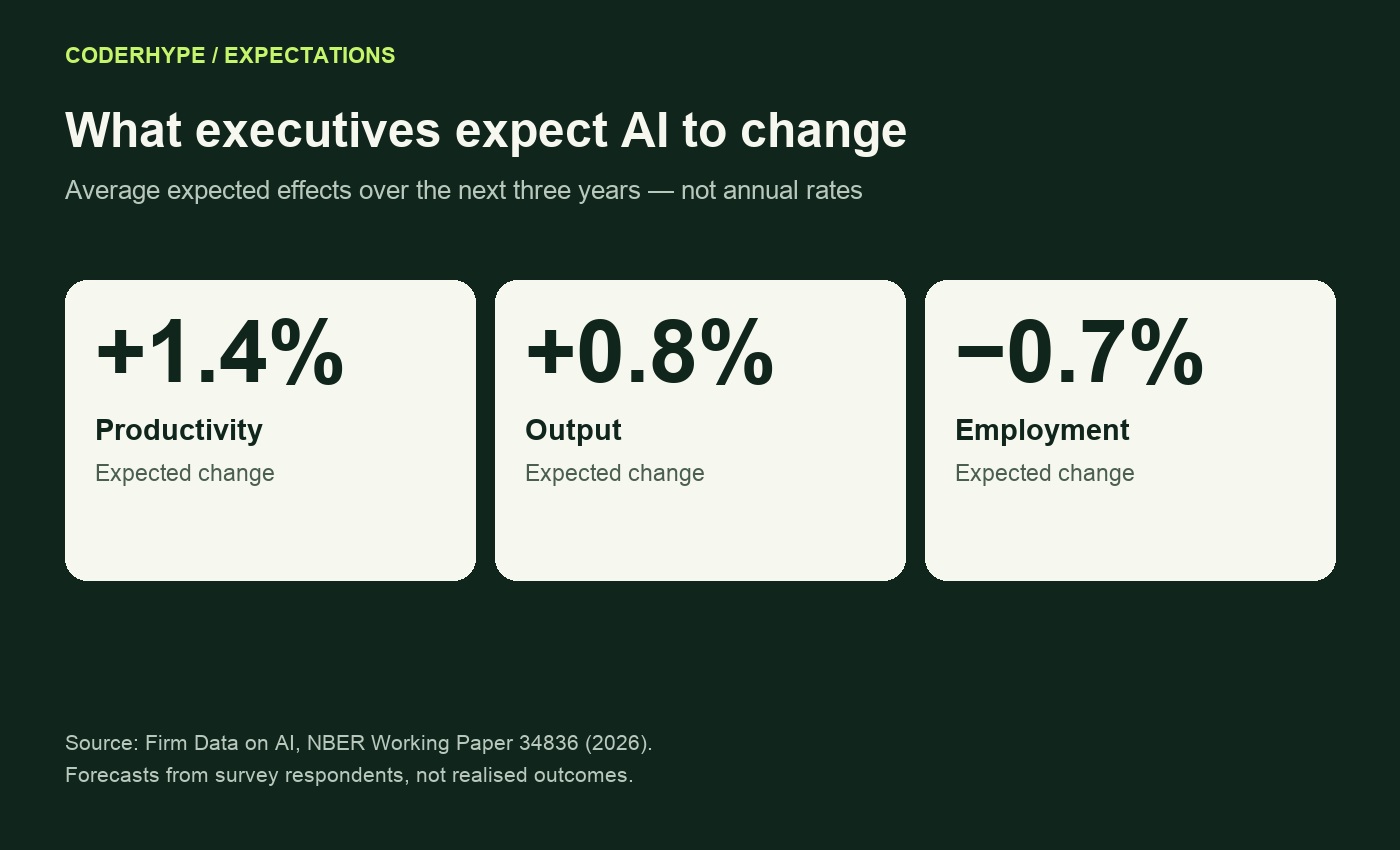
The 2026 working paper Firm Data on AI surveyed nearly 6,000 senior executives in the United States, United Kingdom, Germany and Australia. It reports that 69% of firms used AI, while roughly nine in ten executives reported no effect on employment or productivity over the previous three years. Respondents nevertheless expected productivity to rise 1.4%, output 0.8% and employment to fall 0.7% over the next three years. These are survey reports and expectations, not a causal estimate or a forecast we can treat as achieved. NBER working paper.
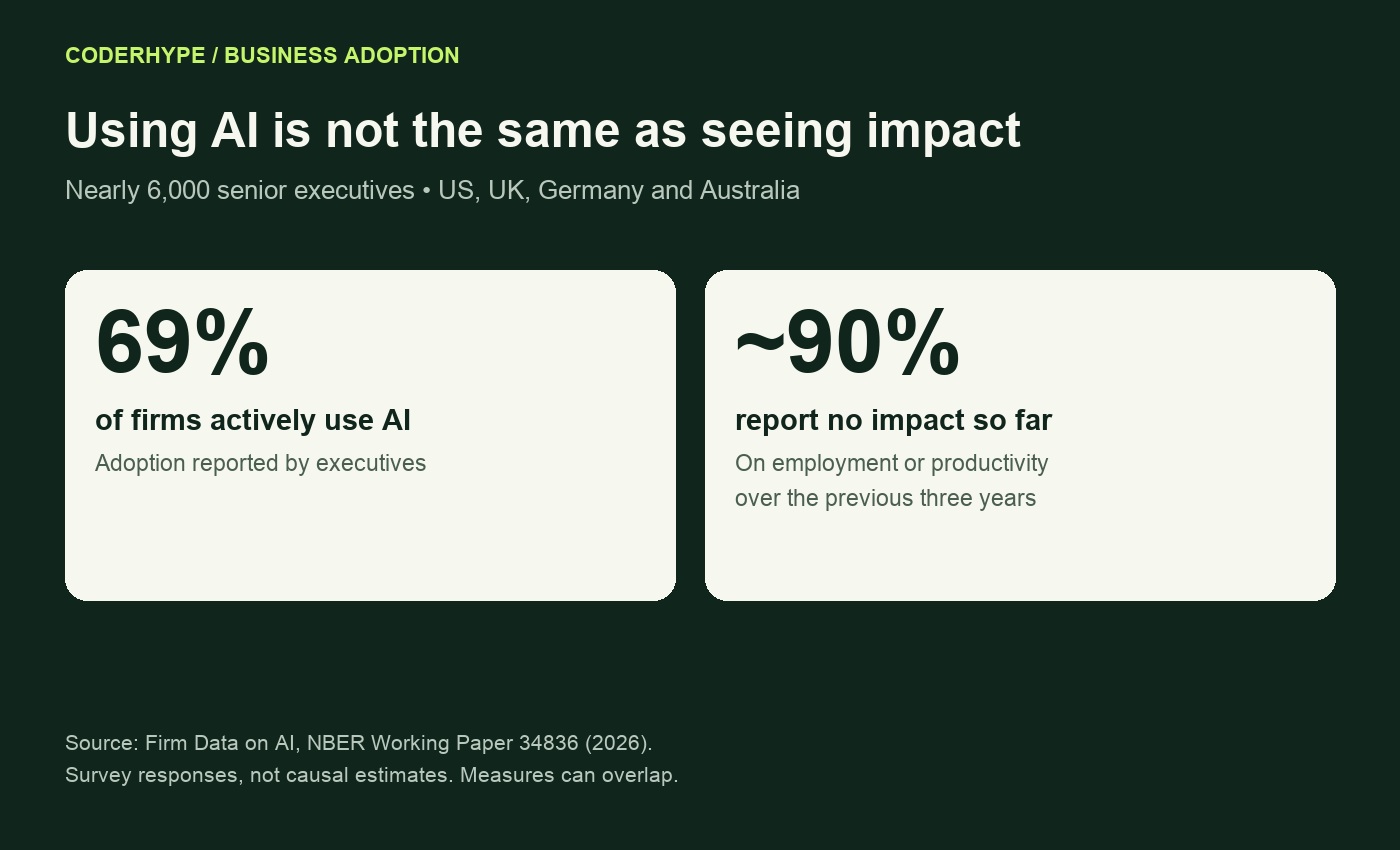
The Bank of England also reports that nearly 90% of firms in its survey had seen no noticeable employment difference so far. It stresses uncertainty about future effects and the possibility of new jobs offsetting losses. Bank of England explainer.
None of this means an individual junior developer, translator or illustrator is safe from disruption. Aggregate stability can coexist with difficult changes in particular occupations. Firms can also reduce hiring rather than fire people, which makes the transition less visible.
For the bubble thesis, the important distinction is timing. If a buyer budgets for an assistant but a seller is valued as though it will replace a department, both can be right about the product and wildly disagree about its economic value. A smaller labour-market effect can disappoint investors without making AI useless.
3. The demo saves time. The deployed workflow does not.
A convincing demonstration leaves out many costs: connecting internal systems, obtaining permissions, handling exceptions, verifying output and taking responsibility when something goes wrong. A deployment has to include them.
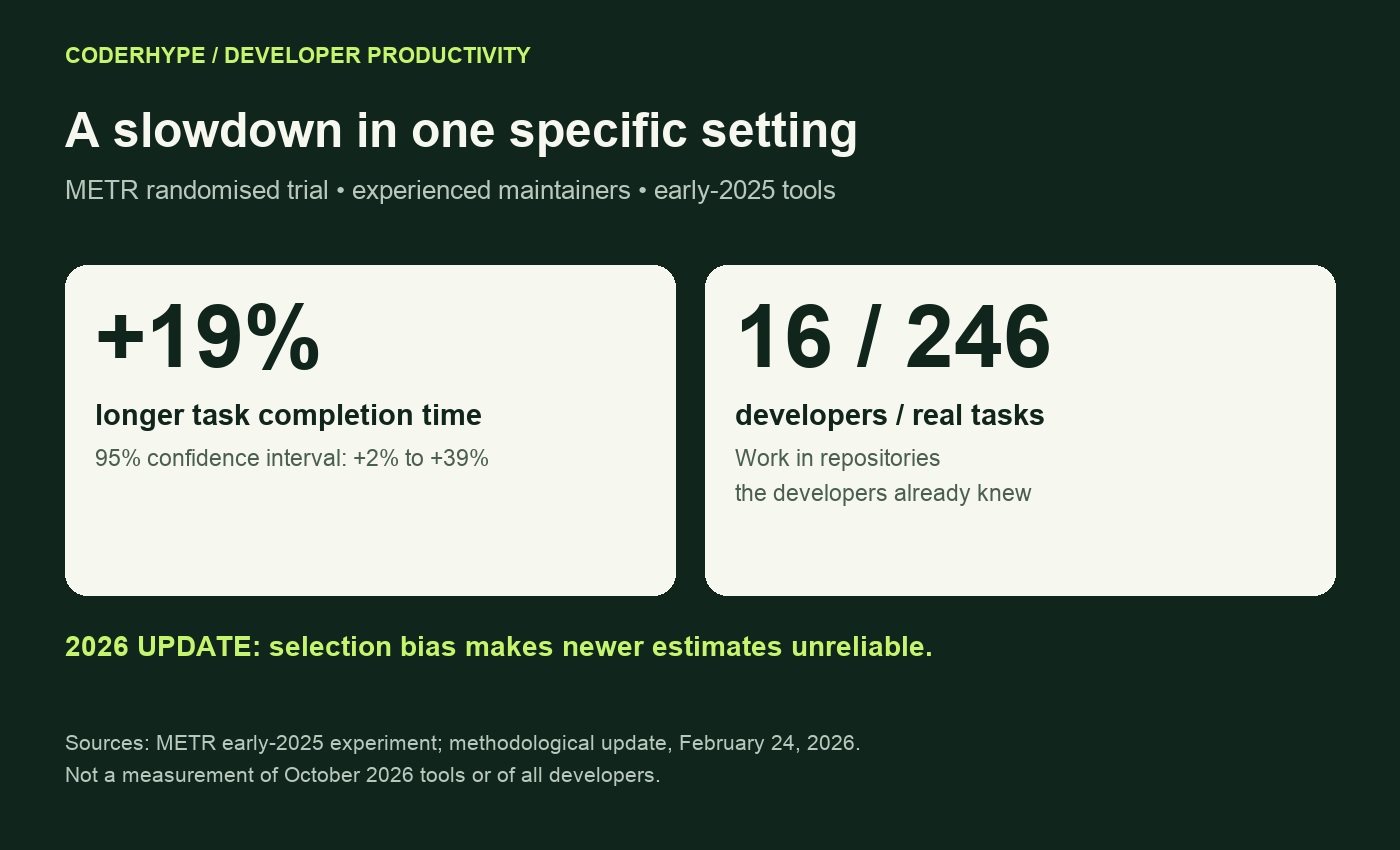
METR’s early-2025 randomised trial involved 16 experienced open-source developers and 246 tasks. Access to contemporary AI tools increased completion time by 19% in that particular setting. The participants were working in repositories they knew well. This was neither a test of all developers nor a verdict on October 2026 tooling. Original experiment.
The follow-up matters. In February 2026, METR said its newer experiment gave an unreliable estimate because participation and task selection had changed. Developers increasingly declined work without AI; concurrent agents also complicated time measurement. The raw results pointed toward speedups, but the researchers warned against reading them as a precise current effect. Using only the older negative headline would misrepresent their position. METR’s methodological update.
There is positive evidence too. The updated Generative AI at Work study reports an average 15% increase in issues resolved per hour across 5,172 customer-support agents, with substantial differences between workers. That shows how a well-defined workflow can benefit; it does not establish the same gain in every occupation. Customer-support study.
Our economic reading is that buyers will become more selective. A pilot should count completed, accepted work per paid hour, including correction and review. If integration and supervision absorb the apparent savings, renewal budgets shrink. The surviving products may be narrower and more useful than the universal assistants sold in the pitch.
4. The training-data supply becomes contaminated
Model collapse is a specific research result, not a synonym for every bad answer. In a 2024 Nature paper, researchers investigated successive generations trained on model-generated data. Indiscriminate recursive training degraded the resulting distributions, including the loss of rarer patterns. Shumailov and colleagues.
This does not establish that every use of synthetic data damages a model. Separate experiments found that retaining original real data while accumulating synthetic generations could avoid collapse in the studied settings. The way data is selected and retained matters. Research on accumulating real and synthetic data.
The plausible business risk is therefore more mundane than “the internet fills with AI and every model becomes stupid.” High-quality, independently grounded data may become more costly to obtain and verify. Unusual cases can matter disproportionately: a system that handles the common case beautifully but fails on rare customer problems may still require expensive human coverage.
If cheap additional data stops producing cheap additional capability, the growth story becomes more capital-intensive. That is a possible constraint on returns, not evidence that model collapse has already overtaken commercial frontier systems.
5. The code works until the next five requests arrive
Writing a first version and maintaining a product are different challenges. A shortcut can pass today’s tests while making the next feature much harder to implement.
SlopCodeBench tests agents repeatedly extending their own code. Its May 7, 2026 revision contains 36 problems, 196 checkpoints and 15 coding agents. No tested agent completed a problem successfully end to end; the best passed 14.8% of checkpoints. Structural erosion increased in 77% of trajectories and redundancy in 75.5%. These figures belong to that benchmark and version, not to all software work. SlopCodeBench v2.
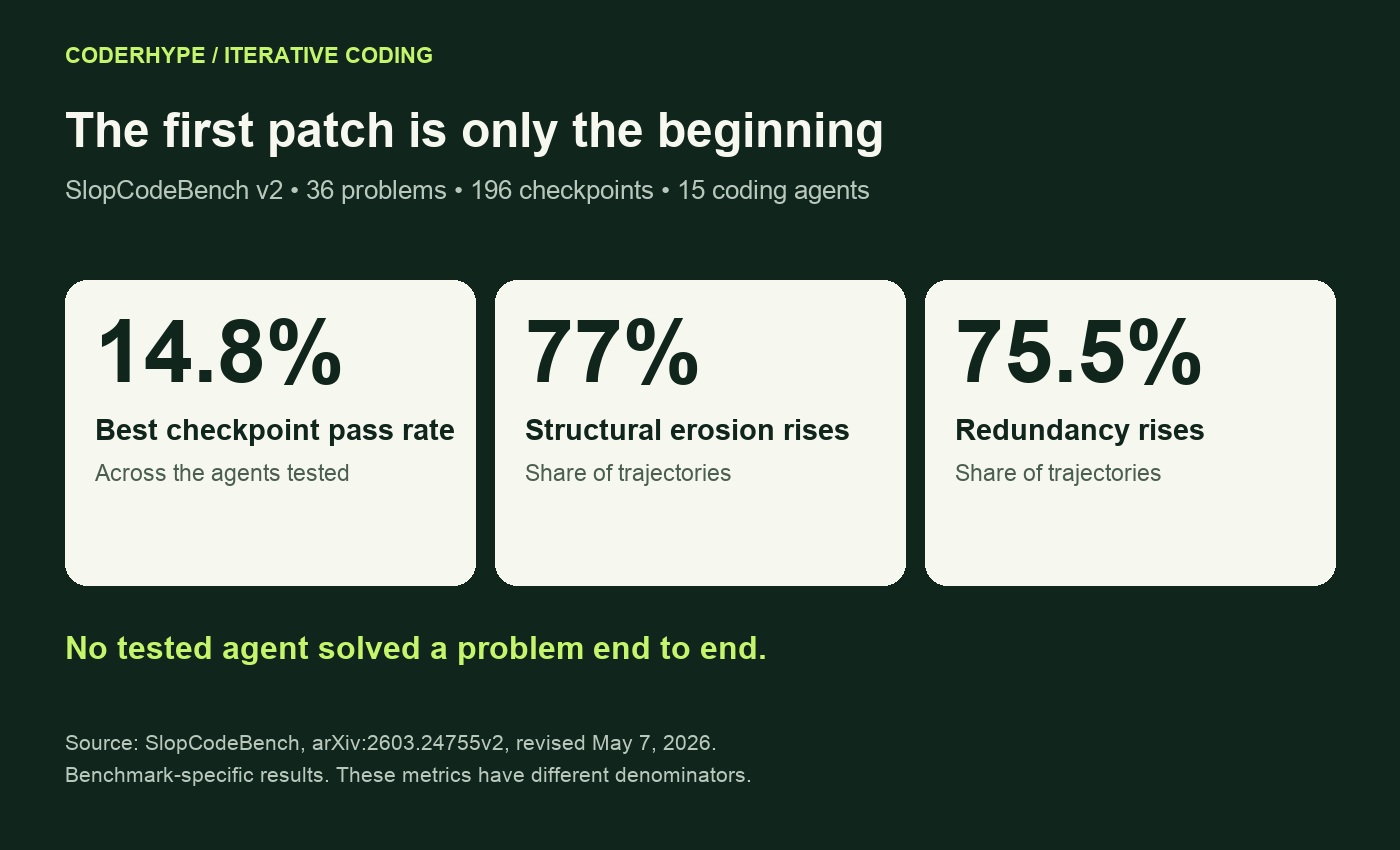
Earlier coverage cites 20 problems, 93 checkpoints and a different best score. Mixing those versions would produce a misleading comparison. More importantly, the study evaluates both correctness and the quality of code as requirements evolve. Passing one step does not establish that the architecture will survive later changes.
For a founder, the risk is deferred maintenance cost. The first prototype looks almost free; the bill arrives when authentication, billing, permissions and migrations must coexist. If every new feature requires disproportionate repair, the promised replacement of a software team becomes a supervised development tool with substantial ongoing engineering costs.
A useful practical response is to measure regressions and review time across successive releases. A good launch demo cannot answer that question.
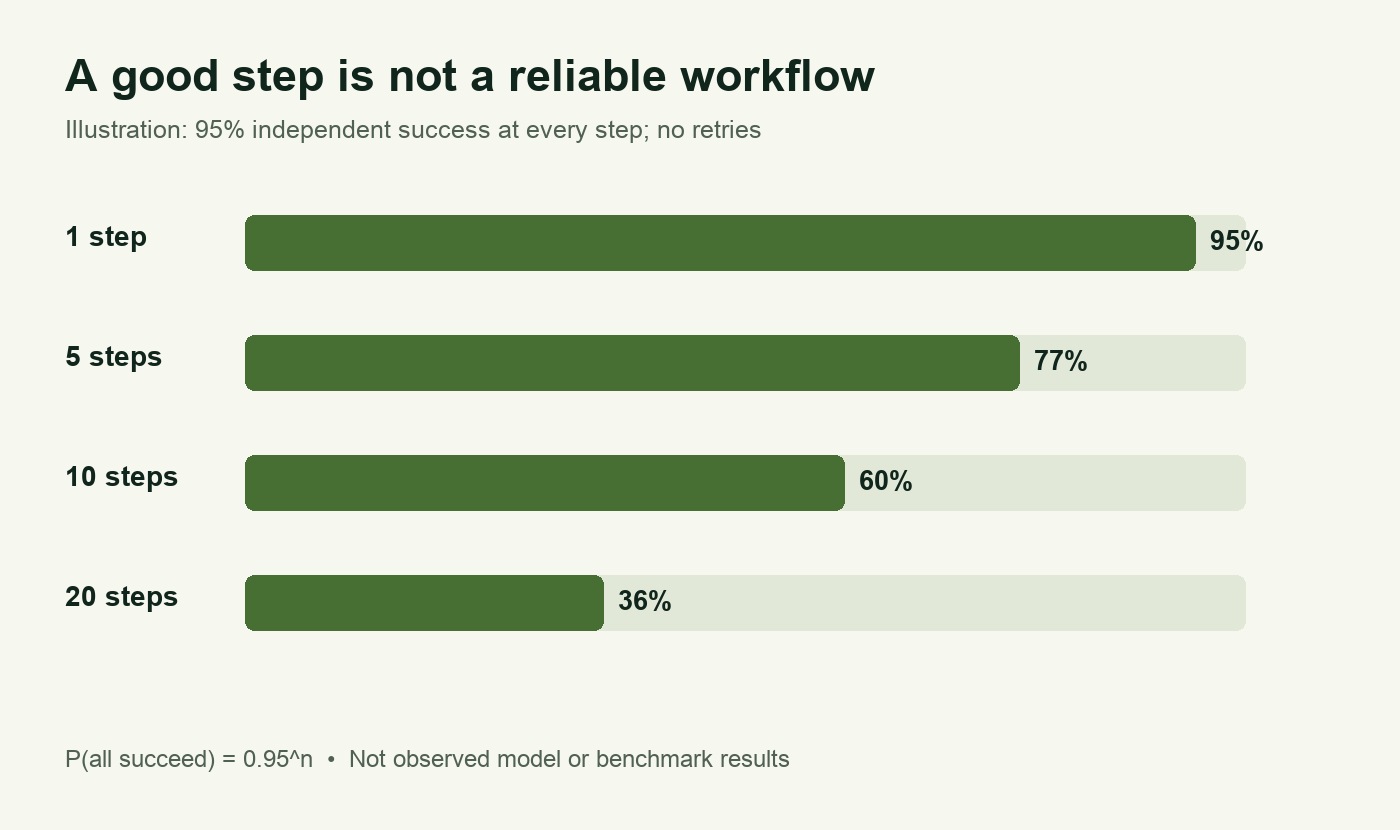
The illustration explains why a high single-step success rate can be insufficient for unattended work. It is not a model fitted to SlopCodeBench. Recovery, tests and checkpoints can improve outcomes; undetected errors that contaminate later steps can make them worse. Reliability has to be measured at the level of the finished workflow.
6. Some limitations may demand more than a bigger model
“Fundamental limitation” is an unusually strong claim. A model failing a task today is an empirical observation. Proving that no future model or tool-using system can solve it is something else entirely.
Apple’s 2025 The Illusion of Thinking study used controlled puzzles to vary complexity. It reported distinct performance regimes and collapse beyond certain difficulty levels, including reasoning effort falling despite remaining token budget. This is evidence about the tested reasoning models and setups, not a proof that machine reasoning is impossible. Apple research.
Follow-up work examined whether agentic scaffolding and external tools change the picture, reframing some failures as a gap between a bare model and a capable system. That is an important qualification: architecture and evaluation design can affect the apparent ceiling. Research response on the agentic gap.
The strongest defensible concern is economic as well as technical. If dependable performance requires formal checks, specialised tools, repeated attempts and human escalation, then intelligence is delivered by the whole system. Its cost cannot be inferred from the price of generating one answer.
A bubble can deflate if investors assume that scale alone will remove these costs and the engineering turns out to be more difficult. That scenario does not require declaring a permanent limit to AI.
7. Recursive self-improvement remains a promise rather than a measured loop
There is a major difference between AI helping researchers write code and a self-sustaining cycle in which AI-driven improvements reliably accelerate the creation of the next, more capable system.
Joi Ito’s Recursive Self-Improvement at OpenAI and Anthropic, revised October 7, 2026, argues that the strict closed-loop claim has not been publicly demonstrated. It distinguishes intermediate automation from evidence that successive development cycles actually accelerate. The report also explicitly identifies itself as substantially AI-generated and AI-maintained under Ito’s guidance. It is a secondary synthesis, not an independent laboratory experiment. Its absence-of-public-evidence assessment should not be converted into certainty about private capabilities. Ito’s report and methodology.
Our proposed test is straightforward in principle and difficult in practice: show successive generations, disclose what humans supplied, keep evaluation standards comparable, account for compute, and measure whether the improvement process itself accelerates. A single agent improving a prompt or a program does not meet that bar.
This matters because self-improvement can become a financial escape hatch: enormous spending now is justified by an expected future research engine. If that engine takes longer than promised, the cash obligations remain. The capability need not be impossible for a timeline-dependent investment thesis to fail.
8. A benchmark winner struggles in a new environment
The October 1, 2026 preprint Evaluating Multi-Dimensional Generalization of Large Language Models in Temporal Extraction Tasks concerns extracting time and event expressions from text. It examines domain shift, adversarial perturbations, compositionality and increasing input length. Its scope is narrower than “can AI work in the real world?” Paper and full text.
The authors actually find that stronger base-task performance generally predicts better generalisation. The qualification is that the relationship weakens under substantial distribution shifts, and improvements are uneven across dimensions. One score cannot reliably summarise all those capabilities. This is a conditional finding, not a claim that benchmarks tell us nothing.
Imagine a hypothetical document-processing pilot that works on clean English forms. Deployment brings scans, regional terminology, inconsistent dates and longer attachments. A favourable test result on the first set does not establish acceptable error rates on the second.
The business consequence is repeated validation and customisation. If each customer needs substantial adaptation, the service starts to resemble an integration business with software inside it. That can be valuable, but it has different margins and scaling characteristics from a universally capable agent that works immediately everywhere.
9. Superintelligence never arrives — or arrives too late for the investment
On October 13, 2026, MarketWatch reported Deutsche Bank’s view that superintelligence might never arrive, attributing the discussion to Jim Reid. The accessible headline and summary also note the possibility of AI productivity gains creating jobs. This is an analyst scenario, not a scientific finding that superintelligence is impossible; the full underlying bank analysis was not independently available for this article. MarketWatch report.
The relevant stress test is simple: would the investment still make sense if AI remained a powerful but fallible tool for the next decade? A product selling useful translation, search or development assistance may have a good answer. A valuation that requires near-term replacement of most cognitive labour has much less room for disappointment.
There is also a less dramatic version. Superintelligence could eventually arrive, but after a particular company runs out of financing, its infrastructure becomes uneconomic or a competitor captures the market. Being right about the distant technology does not automatically make a business model right today.
How these pressures could combine
The scenarios are connected, but they should not be added together as independent probabilities. Reliability affects implementation costs; implementation costs affect customer returns; customer returns affect willingness to pay; willingness to pay affects whether infrastructure commitments can be financed.
| Possible outcome | What would make it visible? | What could survive? |
|---|---|---|
| Slow repricing | Growth continues, but valuations fall as expected margins and timelines are revised. | Useful assistants, specialised applications and profitable providers. |
| Enterprise spending reset | Pilots fail to become renewed production contracts; buyers narrow the scope of automation. | Tools with measurable benefits in specific workflows. |
| Funding shock | A major participant cannot finance obligations, forcing cuts or consolidation. | Services with lower fixed costs and stronger customer economics. |
| Capability plateau | Additional resources produce insufficient improvements in dependable, useful performance. | Applications that already solve valuable problems at sustainable cost. |
These are editorial scenarios, not observed outcomes or probability forecasts. The evidence does not establish when a market correction will happen, how deep it would be, or which company would be most exposed.
The loudest forecasts have not earned the status of facts
The most defensible conclusion is less theatrical than “AI is fake,” and more demanding than “just wait for the next model.” Some of the strongest promises remain unproven; others extend limited demonstrations far beyond what was tested. A deadline that has not yet passed cannot honestly be called a failed prediction. A missed deadline, meanwhile, should not quietly disappear when a new one is announced.
The research reviewed here does not justify treating near-term mass job replacement, universal autonomous coding, effortless enterprise returns or recursive self-improvement as settled outcomes. It also does not justify denying useful AI applications or assuming that present limitations will last forever.
Our view: the bubble is most vulnerable wherever the pitch depends on a future breakthrough to repair today’s economics. Founders have a stronger position when customers pay for a benefit that can already be measured. Investors and buyers should ask for delivered results, the cost of correcting failures and forecasts with definitions and dates attached.
For builders, that means tracking accepted work, repeat usage, retention and gross margin rather than counting generated tokens. Keep a human fallback where errors are costly. Test successive changes, not just the launch demo. Build something worth paying for even if the next grand prediction slips.
AI does not have to stop improving for the hype to run out of money.
Related: What US and European research actually shows about AI and jobs. Building something useful already? Submit your project to CoderHype.