
CrispyVibe keeps several coding agents in one native Mac workspace
A free, open-source macOS IDE that puts coding agents, terminals, files and browser panes in persistent workspaces.
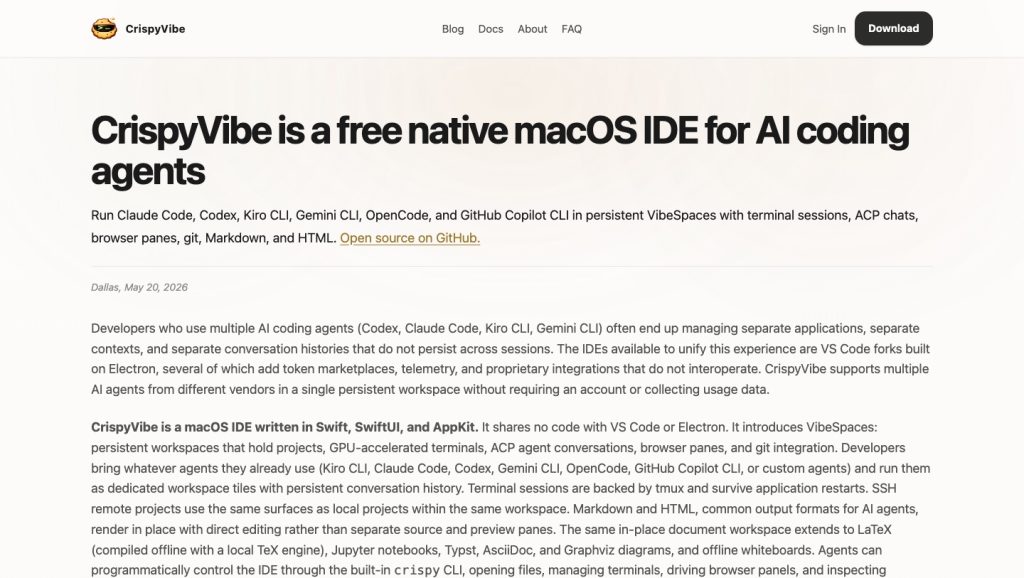
A developer using Claude Code for one task, Codex for another and a terminal for tests can spend as much time recovering context as writing software. CrispyVibe is Manu Mishra's attempt to put those moving parts in one place. Released as a free native macOS IDE in 2026, it groups projects, agent conversations, terminals, browser panes and Git state into persistent workspaces called VibeSpaces. The proposition is practical rather than magical: keep the tools you already use, but stop rebuilding the desk around them each morning.
A workspace that survives the next session
A VibeSpace remembers its project folders, layout, browser tabs and conversations. Terminal tiles can be backed by tmux, so quitting the app does not necessarily end a long-running process or discard its scrollback. Local folders and remote SSH projects can live beside each other; an agent can work in one pane while the developer reads a diff or checks a page in another. CrispyVibe detects installed command-line agents and also supports structured ACP conversations. That lets the interface accommodate Codex, Claude Code, Gemini CLI, OpenCode, Kiro CLI and other tools without making one provider the center of the product.
The editor is more than a terminal collection. Markdown and HTML can be rendered and edited in place, and the site documents support for LaTeX, Typst, notebooks and whiteboards. Those surfaces matter because generated code often comes with documentation, diagrams and previews. Keeping those files in the same workspace can make a small project easier to understand after an agent has changed it. The built-in command-line interface can open files or arrange panels programmatically, but the developer still has the normal editor and Git views to inspect what changed.
The unusual build choice
Instead of beginning with a VS Code fork or an Electron shell, Mishra built CrispyVibe in Swift, SwiftUI and AppKit, with Metal used for terminal rendering. The product page says the code was developed with AI and identifies Kiro CLI as the main tool for specification, implementation and testing. Its repository publishes specifications, technical designs, threat models and usage guides alongside source. That makes the AI-assisted process more inspectable than a vague claim that an IDE was 'vibe coded'. It does not by itself prove that every feature is reliable; it does show how decisions can be reviewed and challenged.
The local-first model is also specific. CrispyVibe says it requires no account, has no paid tier, stores workspace data locally and makes automatic network requests only for optional update checks. The agents a user connects can still have their own accounts, costs and data policies. That distinction is important: a local IDE does not turn every third-party coding service into an offline one.
What has actually shipped
The official site offers a macOS download, documentation and a public source repository. It reports typical memory use of 150–300 MB, but that is the maker's workload-dependent figure rather than an independent benchmark. Availability is narrower than the list of supported agents: the app requires an Apple Silicon Mac running macOS 26 or later. Windows and Linux developers cannot use this build today. No verified active-user count, paid revenue or company valuation appears in the material reviewed. Its concrete result is a released, freely available IDE with a documented engineering process, not a demonstrated mass-market audience.
For a solo maker who works across several agents, the interesting test is whether persistent context reduces the friction of returning to a project after a day away. For someone who needs a mature extension ecosystem or cross-platform parity, a familiar editor may remain the better fit. CrispyVibe's distinctive bet is that an agent era deserves a workspace designed around simultaneous human and machine activity, rather than another chat panel attached to an existing editor.
Sources: CrispyVibe product and founder account; public source repository.
Project page screenshot captured by CoderHype on October 6, 2026 for this independent editorial listing.
CoderHype Score
A quick way to compare projects on CoderHype. Scores can change over time.
Log in to rate this project.
Is this your project?
We listed this project to help people discover it. If you made it, send us a claim and we can put it under your CoderHype account after checking your connection to the project.
More projects to explore

SocialCrawl packages social data behind one API
A social-data API built with AI coding tools. Its October 30, 2026 snapshot showed $45,266 in 30-day revenue, mostly outside recurring subscriptions.

PHPcube
Local PHP source encoding and licensing tools for software distributed to client servers.