How AI Content Erodes Brand Trust
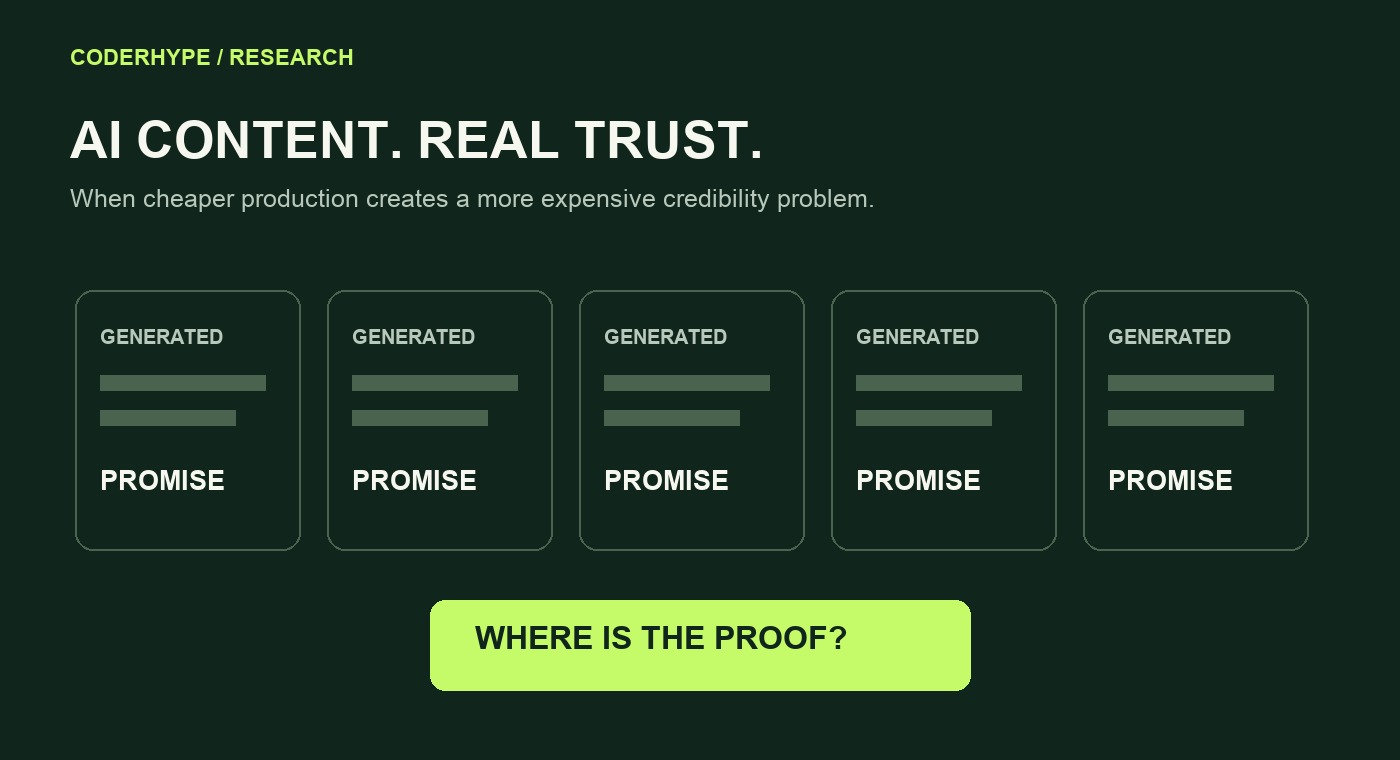
A customer clicks your ad, watches your video and remembers your product. Your dashboard turns green. Then they discover that the person recommending it does not exist, the product demonstration was generated, or the supposedly personal message came from a template. The campaign won attention. It may have spent trust to get it.
That is the uncomfortable question behind AI-generated marketing: what happens when producing a convincing message becomes much easier than earning the right to be believed? The evidence does not support the claim that every AI ad damages every brand. It does reveal several ways brands can make their marketing more efficient while weakening the relationship it is supposed to build.
Research checked October 21, 2026. This article distinguishes consumer surveys, experiments, a conference paper and company financial disclosures. Older work is dated explicitly. Where only an abstract was accessible, we do not invent effect sizes or claim to have reviewed the full methodology.
Watch the video
Consumers are not simply asking for less AI. They are asking what is real.
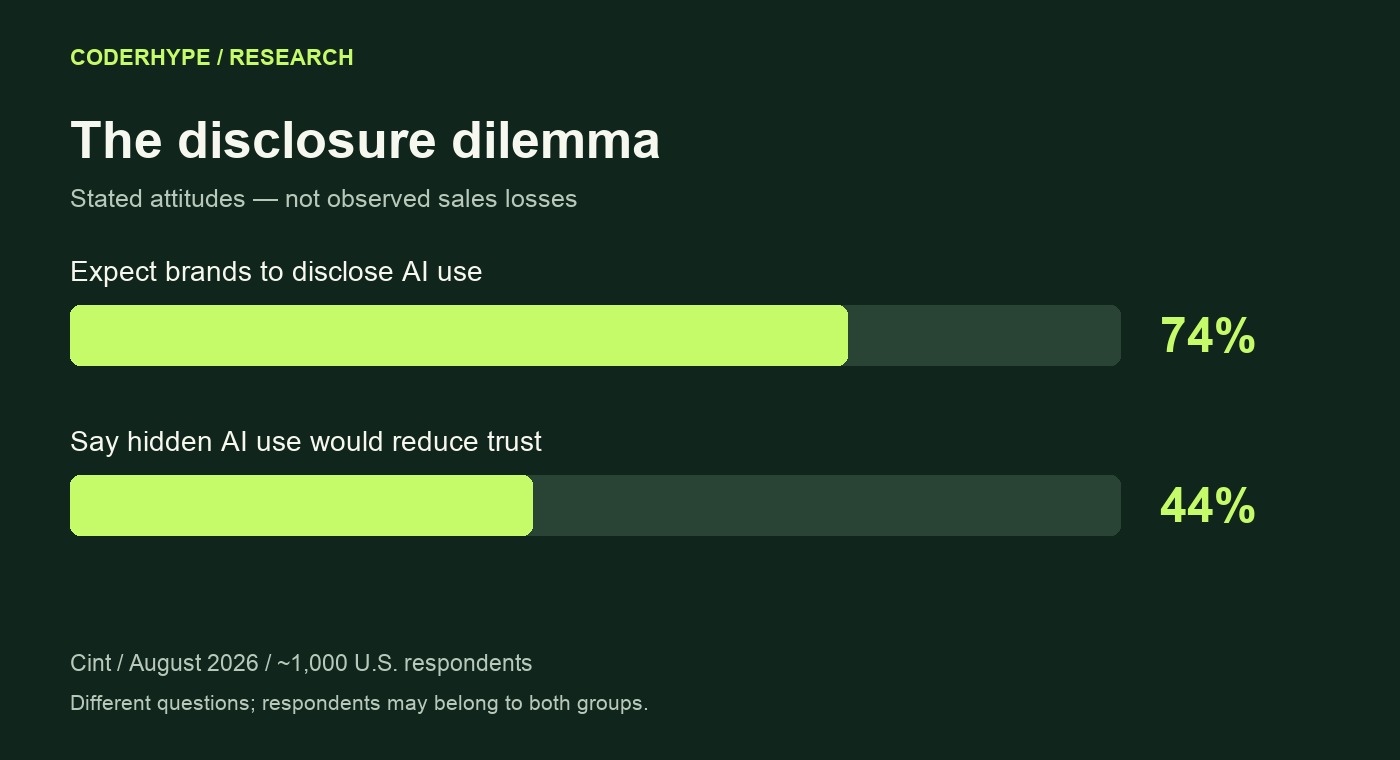
Cint’s October 20, 2026 report offers a timely starting point. In a survey of approximately 1,000 U.S. consumers, conducted in August with Advertising Week, 74% said brands and creators should disclose AI use in advertising. 44% said discovering undisclosed AI-generated advertising would reduce their trust in the brand. These are stated reactions, not a measured 44% decline in a brand-trust score or in sales. Cint’s October report.
Earlier Cint findings also resist the easy headline that everybody hates synthetic advertising. Its April 1 release reported that 44% of U.S. respondents said knowing an advertisement was fully AI-made had no effect on their brand perception, while 28% reported a negative effect. Across its U.S. and U.K. respondents, 27% were very or extremely concerned about AI in advertising. Those figures measure different questions and populations; they should not be combined into a trend line with the October report. Cint’s April findings.
Gartner adds a broader warning. A March 2026 release, based on 1,539 U.S. consumers surveyed in October 2025, found that 50% preferred to give their business to brands avoiding GenAI in customer-facing content. Meanwhile, 68% frequently questioned whether the content they encountered was real. This is not evidence that half of customers actually abandoned AI-using brands. It is evidence of a skeptical environment in which brands have to explain themselves. Gartner survey.
Our reading: the danger is not confined to obviously broken images or robotic copy. A polished piece of content can still create a problem if its apparent authenticity is part of the sales pitch. A fictional illustration and a fabricated customer testimonial are not interchangeable uses of the same technology.
The disclosure paradox: honesty can expose a shortcut
Ripinka Koli Patil and Dan Hamilton Rice examine this problem in Is that your best effort?, published in the Journal of Business Research in 2026. Their abstract reports eight studies across online, laboratory and field settings, plus a within-paper meta-analysis. AI disclosure reduced engagement through a proposed chain: the communication seemed to involve less effort, and the advertised product consequently seemed lower quality. Paper; accessible author abstract.
The effect was conditional. The authors report that human-involvement cues could strengthen the negative effect, while automated-production cues could weaken it. That makes “just add a human-in-the-loop badge” an unreliable universal remedy. The accessible abstract does not establish a single percentage decline that applies across campaigns.
There is no contradiction in wanting disclosure and reacting negatively to what it reveals. A buyer can want an accurate ingredients list and dislike an ingredient. Hiding the information is not a durable answer: the buyer may later judge both the original shortcut and the concealment.
The practical implication is to make the work worthy of explanation. “We used AI to translate a demonstration filmed with our actual product” describes a different promise from “this generated scene shows what our product really did.” The tool is similar; the evidence offered to the customer is not.
Yes, AI ads can win the click
The strongest version of this article must include the evidence that cuts against its title. Heitmann, Jansen, Reisenbichler and Schweidel’s Picture Perfect appeared online in June 2025 and in a 2026 issue of the Journal of Marketing. They fine-tuned a visual model using consumer feedback and advertising objectives rather than merely asking a general model for a nice picture.
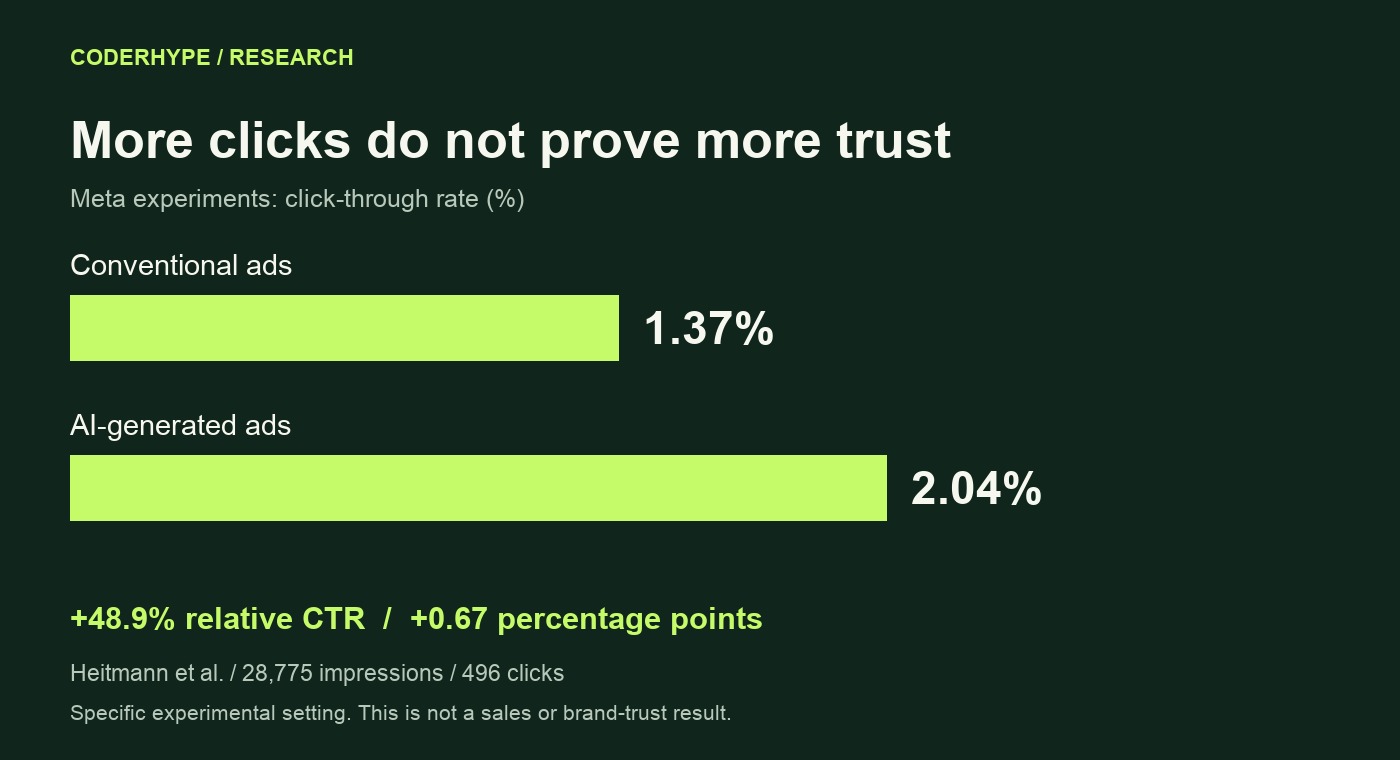
In two Meta experiments involving Polestar-themed advertising, the combined dataset contained 28,775 impressions and 496 clicks. AI creatives achieved 2.04% CTR versus 1.37% for conventional creatives: a reported 48.9% relative increase, or 0.67 percentage points. The researchers also discuss platform and distribution limitations. This is a result for a particular workflow and setting, not a universal advantage for any generated ad, and it does not establish higher sales. Study and results.
This matters because good-looking creative and good marketing are not enemies. Lower production costs can enable useful experimentation. The mistake begins when a team treats the first metric that improves as proof that the whole customer relationship has improved.
A better click-through rate can hide a worse sales funnel
Huimin Li and Qing Li presented Attention Without Conversion? at the June 2026 ISMS Marketing Science Conference. The university’s record describes a randomized field experiment with more than 150 distinct video ads. AI-generated creatives produced higher CTR, better viewer retention and fewer negative reactions, but were less likely to generate conversions than human-created creatives.
This is conference evidence, not a completed journal article we can treat as a settled universal result. The public abstract supplies no numerical conversion effect, denominator or detailed uncertainty estimate. It discusses trust and credibility as possible explanations; it does not let us assign all of the conversion difference to measured trust loss. Conference paper record and abstract.
Here is an illustrative calculation, not the study’s data. With 100,000 impressions, a 1% CTR produces 1,000 visits. If 5% of visitors buy, that means 50 purchases. Increase CTR to 1.5% but reduce post-click conversion to 2%, and the result is 1,500 visits and only 30 purchases. Clicks rise 50%; purchases fall 40%.
That is why a creative test should follow people beyond the landing page. Measure qualified sign-ups, purchases, refunds and repeat use. A striking image may attract curiosity from people who never wanted the product. It may also overpromise something the landing page cannot substantiate. Either mechanism can produce an attractive traffic report and an unattractive business outcome.
When every brand sounds competent, fewer sound distinctive
Doshi and Hauser’s 2024 Science Advances experiment found that access to generative-AI ideas could improve evaluations of individual short stories while reducing diversity across the resulting stories. This was a writing experiment, not a test of brand loyalty, and its older model setup should not be presented as an evaluation of October 2026 systems. Its relevance is the tension between improving one output and making a collection of outputs more alike. Doshi and Hauser.
A separate study, Homogenizing effect of large language models on creative diversity, compared human and ChatGPT writing and reported lower collective diversity in AI output, including after attempts to improve creativity through prompting and parameter changes. That supports concern about sameness, not a claim that every AI-assisted creator becomes unoriginal. Empirical comparison.
For brands, our inference is straightforward. If ten competitors use similar prompts to describe similar products, the result may be ten polished versions of the same message. Fluency improves while identity disappears. There may be no obvious factual error for an editor to remove, yet little remains that a customer could recognize as belonging to one company.
Distinctiveness usually comes from choices: which customer you understand unusually well, which trade-off you accept, what you refuse to promise, what your product actually does differently. A model can help express those choices. It cannot supply evidence that your company has made them.
What remains when the assistant is switched off?
Zhou, Liu, Huang and Li’s Creative scar without generative AI, in Technology in Society in 2026, examines persistence. Its abstract describes an analysis of 419,344 academic papers and a separate seven-day laboratory experiment with two follow-ups, involving 3,593 original ideas and 427 solutions across 18 creative tasks.
The authors report that creative gains fell after AI assistance was removed, while content homogeneity persisted and increased in later follow-ups. These are different study components: the huge paper count is not the sample size of the experiment. We reviewed the accessible abstract, not the complete paywalled methods. The result should not be inflated into proof of permanent cognitive damage or generalized to every tool and profession. Paper; accessible abstract.
For a marketing team, this raises a useful management question even without a sweeping conclusion about cognition: are people learning to develop and defend ideas, or only learning to select the most plausible output? Preserve some unaided concept work. Ask the team to describe the audience and evidence before generating executions. Otherwise, a fast production process can conceal a weak ability to decide what is worth producing.
Shutterstock and Chegg: real financial pressure, but a different mechanism
These companies belong in the discussion because they sell content or access to knowledge. They do not prove that customers punish brands for publishing AI advertisements. Demand substitution, search distribution, acquisition problems and accounting charges are different mechanisms from a loss of trust in a campaign.
Shutterstock’s Q2 2026 revenue was $221.8 million, down 17% year over year. Content revenue fell 17% to $165.7 million; management attributed that category’s decline primarily to weakness in new customer acquisition. The company also reported a $155.9 million net loss, including a $163.4 million after-tax non-cash goodwill impairment. Its release links the impairment to a decline in fair value after its proposed merger was terminated. Calling the full net loss “money lost to AI” would therefore be false. Shutterstock Q2 release.
Chegg’s Q2 2026 revenue was $51.8 million, down 51% year over year. It reported a $3 million net loss, while Skilling revenue increased 2% to $17.5 million. Management described an AI-first restructuring and a move toward employability services. Those numbers establish a severe contraction in the business, but this release does not isolate the portion caused by AI substitution or by consumer distrust. Chegg Q2 release.
The strategic point is narrower and more useful: abundant synthetic output can change what customers are willing to pay for. Meanwhile, content businesses still have company-specific problems and opportunities. A falling revenue line is a prompt to investigate causation, not permission to declare that one technology caused everything.
The riskiest use of AI is manufacturing evidence
Our editorial conclusion is that brands should distinguish material that communicates an idea from material that asks the audience to believe an event happened. An illustrated future workspace is a concept. A video presented as a real customer using your product is evidence. A generated person describing a purchase they never made crosses that boundary.
The same applies to founders. A clear AI-assisted explanation of your application can be useful. A fabricated screenshot, invented revenue figure or synthetic testimonial removes the very proof that an unfamiliar product needs. Small brands have less accumulated credibility to absorb that mistake.
Real demonstrations, attributable customer quotes, dated results and candid limitations give people something to check. They also give the brand something competitors cannot reproduce simply by asking for another variation. The point is not to make every piece of content look deliberately imperfect. It is to keep the underlying claims anchored to something real.
What we would change in a brand’s content process
- Define the claim before producing the asset. Decide whether you are illustrating, demonstrating, reporting or quoting. Do not let a generated illustration quietly become proof of product performance.
- Keep a source for every consequential claim. Save the actual product recording, customer’s permission, underlying dataset or test result. An attractive rendering is not a substitute.
- Explain material AI use specifically. Say what was generated and what was verified. A vague transparency badge tells the audience very little.
- Test the full journey. Evaluate click quality, purchases and retention alongside engagement. Add a clearly worded trust question instead of treating CTR as a proxy for credibility.
- Make room for independent ideas. Develop some concepts before consulting a model, then use it to challenge or execute them. Compare the result with competitors, not just with your previous draft.
- Name a person responsible for publication. Someone needs authority to reject an impressive asset when its promise is inaccurate or its evidence is missing.
These are our recommendations drawn from the evidence, not interventions that all the cited studies directly tested. They apply equally to a large marketing department and a solo founder trying to find the first users for a new product.
Our verdict: cheap content makes credible proof more valuable
AI can help a brand communicate faster and sometimes attract more attention. It can also make effort look absent, turn distinctive ideas into familiar patterns and create a gap between what an advertisement appears to prove and what the business can actually deliver.
The research is strongest when we keep those outcomes separate. A disclosure experiment is not a revenue forecast. A consumer survey is not a purchase record. A creativity study is not a brand-trust study. Put together, however, they give marketers a good reason to stop treating output volume as the central measure of progress.
The competitive advantage is increasingly the part a generator cannot establish on its own: a working product, a real customer, an original observation and a company willing to stand behind its claims. Automate the production work where it helps. Keep responsibility for the promise.
Related: How the AI bubble could burst. Building a product of your own? Share it on CoderHype with a real demonstration and a clear account of what it does.