
5 Vibe-Coded Steam Games Making Money: November 2026 Review
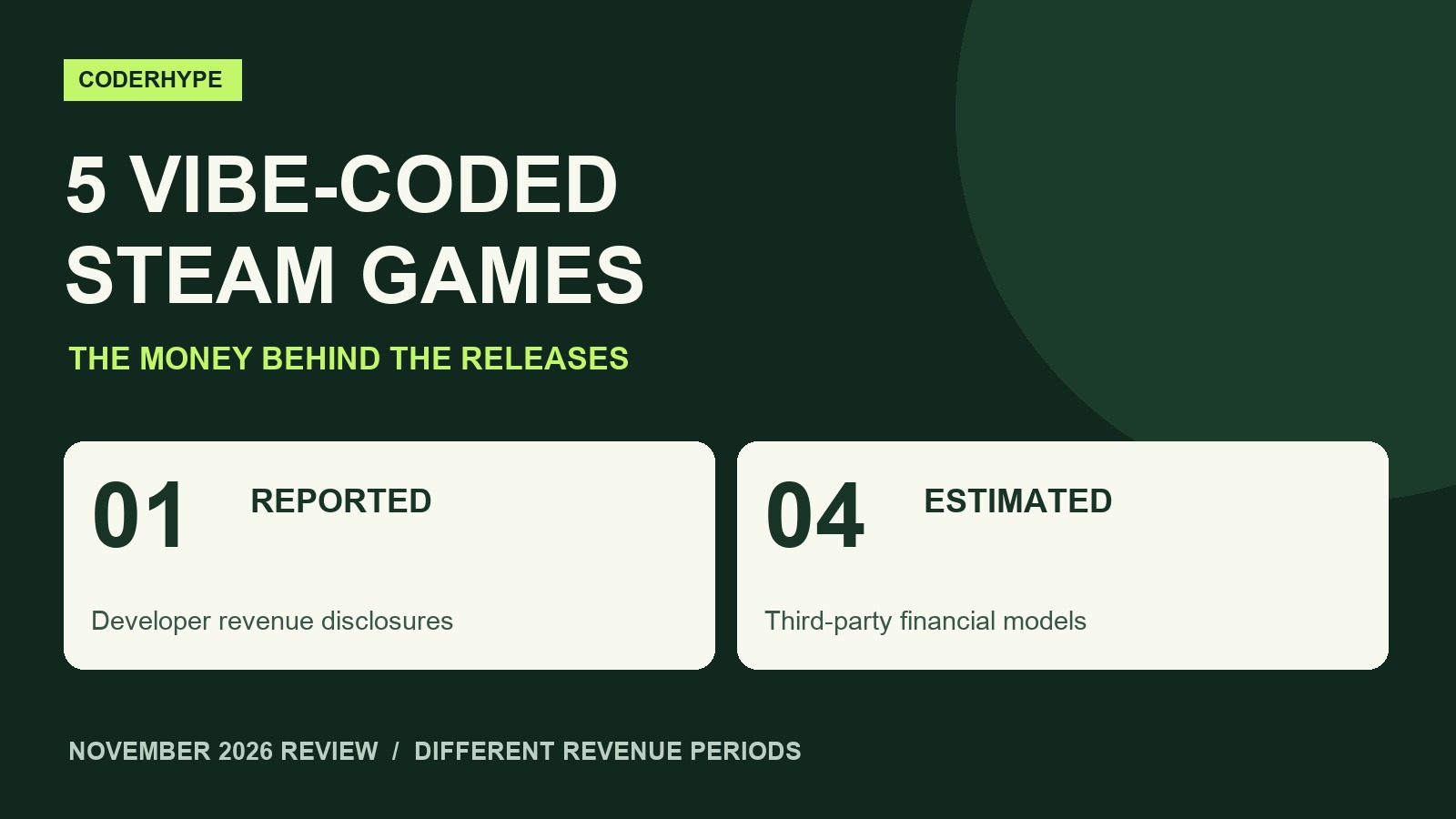
A solo developer reports $356,000 in two days. A logistics game has a third-party launch revenue estimate in the tens of thousands. Smaller simulations have much more modest estimates. All reached Steam with AI involved in their code, but the financial evidence is far from uniform.
For our November 2026 selection, we looked for shipped games with documented AI coding and a public financial signal. Slotbound has developer-reported revenue. Incremental Traffic, Immortal Dao Idle, CODEX MORTIS and KERF have third-party revenue estimates, not disclosed accounts. That difference matters throughout this article.
Data checked November 20, 2026. This is an editorial selection, not a verified ranking of Steam’s five highest earners. November is the review date, not a common release month or revenue period. The figures below cover different windows; none establishes net profit after development costs and labor.
The money, with the labels left on
| Game | Public financial figure | What it measures |
|---|---|---|
| Slotbound | $356K reported | Gross Steam revenue in the first 48 hours; developer post, November 15 |
| Incremental Traffic | About $85.8K estimated | gamesELO lifetime gross estimate, November 9; modeled range $51.5K–$137K |
| Immortal Dao Idle | About $31.2K estimated | Raijin lifetime gross estimate; November 15 snapshot |
| CODEX MORTIS | About $8K estimated | Raijin lifetime gross estimate; November 10 snapshot |
| KERF: Sawmill Tycoon | About $6.8K estimated | Raijin’s October-end lifetime estimate, visible in its November snapshot |
1. Slotbound: the demo built the business before launch
Slotbound gives players a simple proposition: spin a 3×3 slot machine to summon an army, then use upgrades and combinations to survive an auto-battler. The idea is readable in seconds. That is useful both inside the game and when a stranger encounters a clip of it.
On November 15, developer Optima Arch reported $356K in gross Steam revenue and 50,000 copies sold in the first 48 hours. The post is also available in a public text mirror. A later Steam announcement reported 200,000 copies. That later unit milestone is not a new dollar disclosure: multiplying it by the US sticker price would ignore regional prices, discounts and refunds.
The development story is unusually well documented. In an early first-person Reddit post, Optima Arch said the demo’s code was generated with AI, named LÖVE as the engine, and discussed Copilot, Cursor and other assistants. The same discussion distinguishes purchased unit assets from generated visuals. An October clarification says the original post described the demo and that the full version involved substantial additional work and hand-drawn human art. Calling the finished release a completely automated product would erase that distinction.
More revealing than the tool list is the audience-building timeline. The developer reported growing from 590 wishlists at the demo launch to more than 70,000 a month later. Those are wishlists, not purchases, but they show that demand existed before the paid release.
Our reading: the strongest part of this case is the playable demonstration of the idea. AI helped make the game possible; an understandable mechanic and a demo gave people something to respond to. The revenue is developer-reported, and no public cost breakdown here lets us calculate final profit.
2. Incremental Traffic: your success creates the next traffic jam
Incremental Traffic turns business growth into its central problem. Deliveries pay for more trucks and faster production, but the extra vehicles clog the same streets. The player manages the resulting bottlenecks with signals, priorities, lanes and roundabouts. It is a readable loop: improve the business, break the traffic flow, then fix the network.
Rischer Kriebl released the game on Steam in early November. The developer’s AI disclosure explicitly describes collaboration with an AI coding assistant, including the code that renders the visuals. It also mentions assistance with text and translation, while distinguishing these from AI-generated images, textures, sounds or music. No specific assistant, development budget or percentage of AI-written code is disclosed.
gamesELO’s November 9 snapshot estimates approximately $85,800 in lifetime gross Steam revenue, with a modeled range of $51,500–$137,000. This is a third-party calculation, not a developer financial report. It covers the launch period available to that snapshot, not the whole of November. We have not verified the actual payout or profit.
The useful design lesson is how the game makes progress visible. A growing fleet creates a problem the player can see, and the next intervention has an understandable purpose. That gives a short gameplay clip something concrete to communicate. It does not establish which marketing channel brought the buyers: no verified acquisition breakdown was found.
For another builder, the opportunity is to study that feedback loop rather than copy the revenue estimate into a forecast. A system that is satisfying to operate still needs balancing and testing, even when an assistant produces much of its implementation.
3. Immortal Dao Idle found a specific audience to build for
Hyro’s starting point was a taste for xianxia and wuxia stories and dissatisfaction with existing cultivation idle games. The resulting multiplayer RPG combines character growth and cooperative play. Its store page promises cosmetic or support purchases rather than paid progression.
The developer’s Steam disclosure is specific about the AI contribution: artwork and backend code, directed by someone with an IT background who did not consider themselves a coder. It does not establish that every part of the client was AI-written, and it does not name a model. This belongs in the broader AI-assisted coding category, with that narrower claim preserved.
Raijin’s November 15 snapshot estimates about 4,300 copies and $31,200 in lifetime gross revenue. These are modeled figures. Hyro has not supplied a financial statement in the sources used for this article, so the actual revenue and profitability remain unverified.
The interesting product decision is the audience. A cultivation idler offers a recognizable fantasy to readers already interested in that genre. An online economy also creates continuing obligations: persistence, exploits, balancing and support. For a prospective builder, this case is a reason to examine a niche carefully, not a reason to assume that generating backend code finishes the business.
4. CODEX MORTIS: one prompt started it; two rewrites helped ship it
CODEX MORTIS combines survivor-style combat with spell combinations and deckbuilding. Steam records a March Early Access launch and a full release on September 24. It is a commercial game with a development history, rather than a one-shot prototype being presented as a finished product.
In a first-person production breakdown, a developer writing as Crunchfest3 describes a first prototype produced from a simple request, followed by performance problems and two complete rewrites. The eventual stack used TypeScript, PixiJS and bitECS. Adding more enemies exposed weaknesses that the initial fast iteration had hidden.
The money is less firmly documented than the engineering. Raijin’s November 10 snapshot estimates roughly 2,500 copies and $8,000 in lifetime gross revenue. That is a third-party estimate, not a Steamworks screenshot or a publisher disclosure. We cannot derive profit from it.
For someone trying to reproduce the workflow, the rewrites deserve more attention than the opening prompt. The creator’s account suggests that useful specifications, an appropriate architecture and repeated testing became necessary as the scope expanded. The ability to generate code quickly reduced one kind of friction; it did not remove the need to discover why a build failed under load.
CODEX MORTIS on Steam · Our project profile
5. KERF: a sawmill simulator with a reason to stream it
KERF: Sawmill Tycoon puts the player inside the work: cutting trees, processing timber, crafting products and serving customers. Its streamer integration lets viewers appear as customers. That gives a creator a way to involve an audience in the session, although the public sources do not quantify how much traffic or revenue this feature generated.
MGDB Studio’s press kit identifies a one-person Polish studio, Unity 6 and an August 20 release. The Steam disclosure says an AI coding assistant wrote the code. It also explains the use of generated models, scripted 3D construction, animation, music and translations. The developer directed and reviewed the output; the listing does not say which coding assistant was used.
The available financial signal is Raijin’s estimate of about $6,800 in cumulative gross revenue at the end of October, visible in its November snapshot. It is not November revenue, and it is not money verified as paid to the developer. No public development budget establishes whether the project recovered its total costs.
KERF is worth studying for the choice of a concrete activity and a distribution-friendly feature. A viewer can understand a sawmill without an explanation of AI tooling. Whether that becomes a durable business depends on the game, its audience and continued support—questions that the estimate alone cannot settle.
What these five cases actually tell a new developer
The evidence supports a narrower, more useful conclusion than “vibe coding makes games profitable.” AI-assisted games can reach a paid Steam release, and some creators have disclosed real sales. The range of outcomes is enormous. Slotbound’s launch is not a reasonable default forecast for the next game, and even positive gross revenue can leave development costs and labor unpaid.
Three practical questions come before a revenue target. Can a stranger understand the appeal from a short clip? Does a playable demo make them want another run? Is there a community interested in the underlying genre before it hears about the development tools? These cases give reasons to test those questions early. They do not prove a universal marketing formula.
For financial planning, keep the arithmetic attached to the evidence. A price is not realized revenue per copy. A review is not a sale count. Cumulative revenue is not monthly income. And a third-party model is not a developer’s bank statement.
How we checked the selection
We used developer accounts and Steam disclosures to establish AI coding involvement. Financial figures are labeled at the point of use. Slotbound is developer-reported. Incremental Traffic uses gamesELO’s explicitly modeled estimate; the remaining three come from Raijin’s modeling of public Steam data. Such estimates can be revised and should be treated as approximate signals, not verified earnings. The selection does not claim comprehensive coverage of all AI-assisted games, nor that every game was coded entirely by AI.
For the earlier release-focused comparison, see five vibe-coded games that shipped on Steam. Building your own game or app? Submit it to CoderHype and give potential users something they can try.