
Why Anthropic Stock Fell After Its IPO: 6 Theories
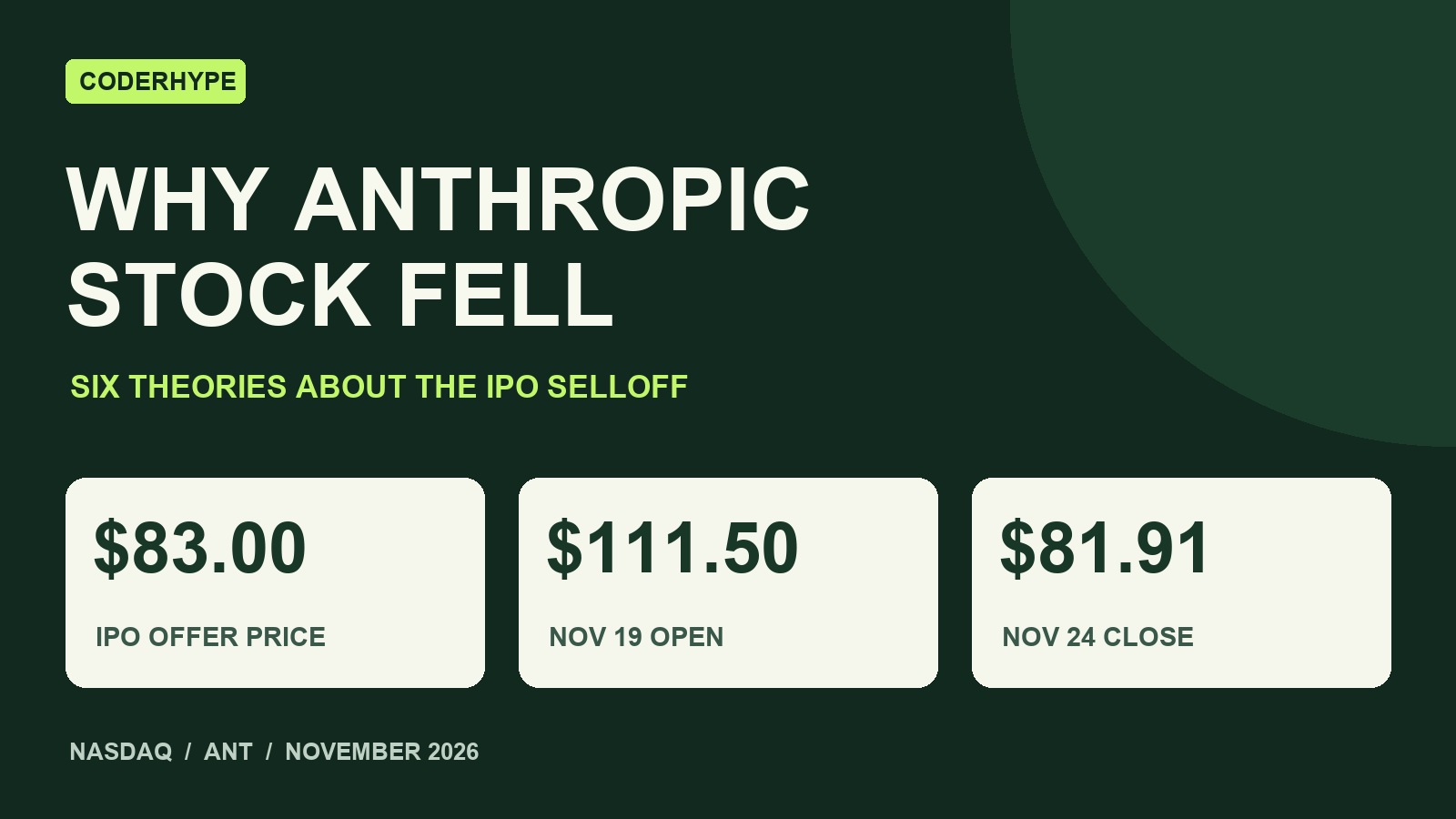
Anthropic priced its Nasdaq IPO at $83. On November 19, the first public trade went through at $111.50. By the November 24 close, shares were down to $81.91, about 27% below the opening trade and 1.3% below the offer price. The IPO raised $93.5 billion in gross proceeds, including the extra shares the underwriters bought. Here are six explanations for how a record IPO turned into a selloff within days. Anthropic’s IPO announcement · Reuters on the debut · Axios on the November 24 close
1. Anthropic went public in the middle of an AI selloff
The S&P 500 was already on a losing streak when Anthropic began trading. On IPO day, it fell another 2%, the Nasdaq Composite dropped 2.25%, and Nvidia fell 3.3%. Investors hoping the debut would revive demand for AI stocks got a brief rally in Anthropic itself. By the close, the stock had given back more than half its peak gain over the offer price. The market-wide explanation is that investors were cutting exposure to the same group of stocks just as Anthropic joined it. Reuters on the November 19 selloff
2. The opening price assumed years of exceptional growth
Fund manager Peter Andersen told Reuters that the IPO probably came in overpriced and that the subsequent trading was where investors started finding a price they could live with. Morningstar’s analysis shows how much hangs on the growth assumptions. Its base case put Anthropic at $92 per share, assuming revenue grows 47% a year for five years. Its bear case came out at $25, with slower adoption and delays in bringing computing capacity online. Anthropic’s first public trade was almost $20 above Morningstar’s base case. Buyers at that price were paying for a stronger trajectory. Reuters on price discovery · Morningstar’s valuation scenarios
3. The compute bill was already on the calendar
Anthropic’s prospectus disclosed $900.9 billion in purchase and lease commitments. About $70.7 billion was due in the 12 months after September 30, 2026, and $451.6 billion was expected by the end of 2030. The theory is that Anthropic has had to reserve capacity years before it knows exactly how much customers will use. Slower demand means carrying the cost for longer. Delayed data centers mean less capacity to serve demand that already exists. StoneX analyst Fiona Cincotta pointed to that second risk as a drag on future revenue and valuation. SEC prospectus · StoneX analysis via Reuters
4. More Claude usage could still mean a weaker quarter
Revenue jumped from $2.5 billion to $33.2 billion in the first nine months of 2026 compared with the same period a year earlier. Yet Anthropic went from $974 million in operating profit in the June quarter to a $567 million operating loss in the September quarter. The filing points to $5 billion of higher-cost short-term compute and $2 billion in noncash charges tied to its donation-matching program. A rush of new Claude usage can force Anthropic to rent capacity at a premium. Sales rise immediately, while the cheaper infrastructure needed to serve that traffic takes longer to arrive. Anthropic’s financial disclosures
5. Claude’s rivals can compete on price and distribution
Bloomberg reported that Anthropic fell after hours on debut day as news broke that Apple was developing its own AI agent. Apple’s advantage in that scenario is distribution through devices people already use. Open-weight developers such as DeepSeek, Moonshot AI and Mistral pose a different challenge. A company can use Claude for its hardest coding jobs and send routine work to a cheaper model. That shift can put pressure on what Anthropic charges for everyday usage, even if customers keep paying for Claude on the tasks that matter most. Bloomberg on Apple’s agent plans · Reuters on open-weight competition
6. Buyers were watching how many shares could come to market
Anthropic’s prospectus said up to 315 million Class A shares held by eligible directors, officers, employees and consultants could become available for sale from the first trading day. Up to 3.4 billion more could become eligible before the main lockup period ended. Investors cited by The Wall Street Journal also questioned how early the underwriters exercised their option to buy 147 million additional shares. Using it in full removed one potential tool for supporting the price in the aftermarket. The trading explanation is that, with more shares eligible to come to market, buyers had less reason to chase the opening price. SEC lockup disclosures · Axios on investor reactions
Anthropic’s first four trading sessions put three questions in front of public investors. How fast will Claude usage grow? How much will it cost to serve that usage? And how much will customers pay as rival models improve? The IPO opening price put a number on the optimistic answers. The selloff showed how quickly investors could change what they were willing to pay for them.
Related reading on CoderHype: How the AI Bubble Could Burst.